Introduction: You Can Decorate a Rental. Here’s How to Do It Right.
Over 44 million Americans rent their homes. Yet most decorating advice online is written for people who own their walls — people who can paint, drill, and renovate on a whim. If you’re a renter, you’ve probably Googled ‘how to decorate without damaging walls’ at 11 pm and found either surface-level listicles or Pinterest boards full of $8,000 renovation reveals.That ends here.
This guide covers every room, every budget, and every landlord scenario with one non-negotiable constraint: everything must be fully reversible. No damage, no lost deposit, no apology letter to your property manager. Just a home that actually feels like yours.
Whether you’re in a 400 sq ft studio or a 1,500 sq ft rental house, these renter-safe decorating tips are actionable, specific, and tested — not just theoretically deposit-friendly.
| RENTER REALITY CHECK: The average security deposit in the U.S. is $1,500–$2,500. A single patched nail hole typically costs $50–$150 to repair professionally. Knowing which decorating methods are truly damage-free isn’t just aesthetic — it’s financial protection. |
1. What ‘Renter-Safe’ Actually Means (and What It Doesn’t)
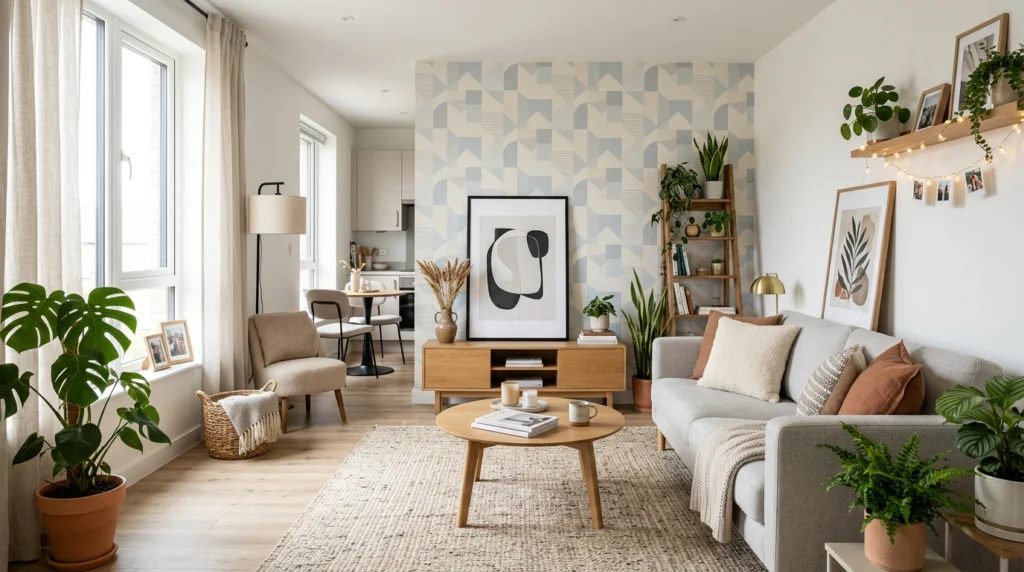
‘Renter-safe’ is not the same as ‘bare walls and zero personality.’ It means using methods that leave no permanent mark — and that’s a surprisingly wide creative territory once you understand the tools available.
Renter-Safe = Fully Reversible
Any decorating choice qualifies as renter-safe if it can be completely undone before you move out, leaving the space in the same condition as when you moved in. That includes:
- Wall treatments that leave no holes, residue, or paint
- Floor coverings that don’t require adhesive or installation
- Furniture that sits on (rather than into) the floor
- Lighting that doesn’t require new wiring or ceiling modifications
- Window treatments that use no-drill hardware
What It Doesn’t Mean
Renter-safe does not mean cheap, minimal, or aesthetically compromised. In 2026, the market for temporary, removable, and renter-friendly products is larger and better than it has ever been. Removable wallpaper now convincingly mimics real wallpaper. Command strips hold up to 16 lbs. Peel-and-stick tiles replicate tile and hardwood. The tools exist — you just need to know which ones to use and how.
| PRO TIP: Always photograph your rental before decorating and after you’ve moved everything out. Date-stamped photos are your best evidence if a landlord disputes the condition of the property at move-out. |
2. The Golden Rules Before You Decorate a Rental

Before you buy a single peel-and-stick tile or command hook, run through these rules. They will save you money, stress, and your deposit.
Rule 1: Read Your Lease
Some leases prohibit any wall modifications, including picture-hanging strips. Others explicitly allow small nail holes. Know exactly what your lease says before you decorate. If it’s ambiguous, ask your landlord in writing — email works perfectly. Documented permission is worth far more than a verbal okay.
Rule 2: Test Every Adhesive Product First
Adhesive products — command strips, peel-and-stick wallpaper, removable hooks — can behave differently on different wall finishes. Freshly painted walls, textured walls, and older painted plaster can all react differently. Always test in an inconspicuous area (inside a closet or behind a door) and let it sit for 48–72 hours before committing.
Rule 3: Follow the Product Instructions Exactly
The single biggest cause of renter-decorating damage isn’t the product — it’s the removal process. Command strips must be pulled slowly and straight down. Peel-and-stick wallpaper must be removed at a 45-degree angle. Skipping the instructions is how you lose chunks of wall paint and your deposit along with it.
Rule 4: Keep All Original Hardware
If you swap out cabinet hardware, a showerhead, or a light fixture, keep every single original piece in a labeled bag or box. You will need to reinstall them before you move out. Losing the original towel ring costs you $40–$120 at move-out — not because the landlord needs it, but because you’ll need to replace it.
Rule 5: Budget for Move-Out
Set aside 10–15% of your decorating budget to cover move-out cleaning and any touch-up supplies. A magic eraser, some wall patching compound, and a small can of touch-up paint (if your landlord allows minor touch-ups) can be the difference between a full deposit return and a deduction.
3. Walls: The Biggest Opportunity in Any Rental
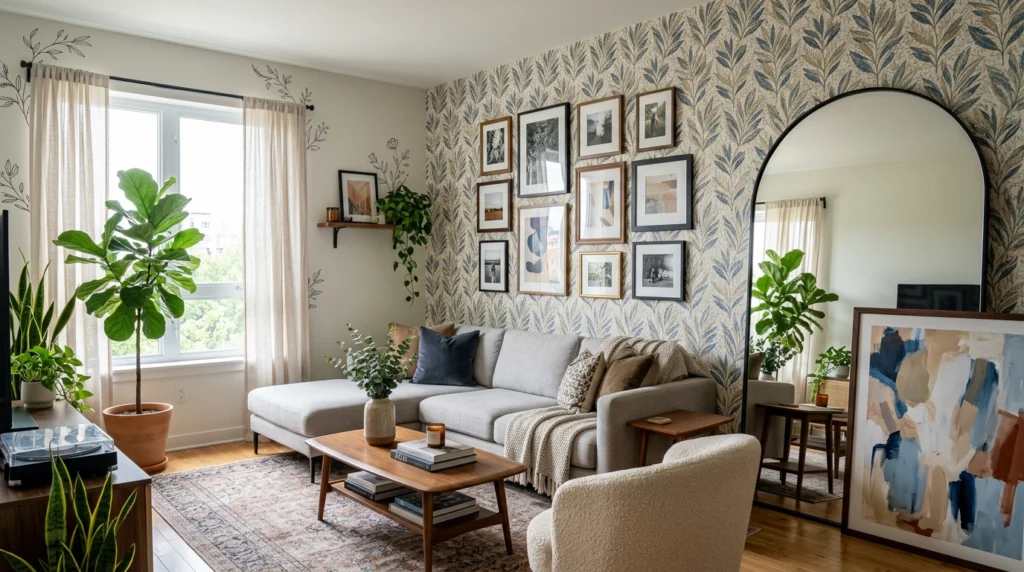
Walls are where most renters feel most constrained — and where you actually have the most creative freedom if you know the right products. Here’s a complete breakdown of every renter-safe wall strategy, from free to $200.
Removable Wallpaper: The Game-Changer
This is the single most transformative renter-safe product on the market. Quality peel-and-stick wallpaper today is nearly indistinguishable from traditional wallpaper — and it comes off cleanly without damaging paint when removed correctly.
| Product Type | Best Use / Notes |
|---|---|
| Peel-and-stick wallpaper (woven) | Best for accent walls; more forgiving on removal; $1.50–$4/sq ft |
| Peel-and-stick tile (backsplash) | Kitchen and bathroom accent areas; looks like real tile; $0.80–$2.50/sq ft |
| Fabric wallpaper (starch method) | Uses liquid starch as adhesive — completely removable with water; ideal for textured walls |
| Repositionable mural panels | Large-format art murals; repositionable before full adhesion; $80–$250 for a feature wall |
| Temporary grasscloth | Adds texture; works on smooth walls only; $2–$5/sq ft |
Key installation tip: always clean the wall with rubbing alcohol before applying any peel-and-stick product. Dust and grease are the primary reasons removable wallpaper doesn’t adhere cleanly — or removes paint when taken down.
Command Strips and Adhesive Hooks: What Actually Holds
Command strips have become a standard renter tool, but most people don’t know their weight limits — and that’s where things go wrong. Here’s an honest breakdown:
| Command Product | Max Weight | Best Use |
|---|---|---|
| Small Command Strip (1 pair) | 4 lbs | Lightweight frames, small mirrors |
| Large Command Strip (1 pair) | 16 lbs | Heavier frames, coat hooks |
| Command Outdoor Hook | 7.5 lbs | Damp bathrooms, garage |
| Velcro Picture Hanging Strips | 16 lbs per pair | Canvases, wooden frames |
| Adhesive Shelf Brackets | 11–15 lbs per bracket | Floating shelf systems |
| WEIGHT LIMIT WARNING: Command strips’ weight ratings assume new strips, properly cleaned walls, and correct installation. In practice, give yourself a 25% safety margin — treat a 16 lb strip as reliable to 12 lbs. |
Gallery Walls Without Nails
A gallery wall is absolutely achievable in a rental using adhesive strips — but requires more planning than a traditional nailed gallery wall. Lay out your arrangement on the floor first, photograph it, then transfer it to the wall using painter’s tape to mark positions before adhering anything. Start from the center out, not the edges in.
Leaning Art and Decor
One of the most underrated renter-safe strategies: lean large art, mirrors, and shelving rather than hanging them. A large canvas leaning against a wall looks intentional and styled — not lazy. A full-length mirror leaning in a corner makes any room feel 30% larger. A ladder shelf leaning against a wall adds vertical storage without a single hole.
Removable Wall Decals and Panels
Wall decals have evolved dramatically from the 2010s vinyl stickers. In 2026, you’ll find high-quality fabric decals, wooden 3D wall panels with adhesive backing, and repositionable art prints that look like framed pieces. These are excellent for renters who want wall interest without the weight or permanence of traditional art.
4. Floors: Working With (and Around) What You’ve Got
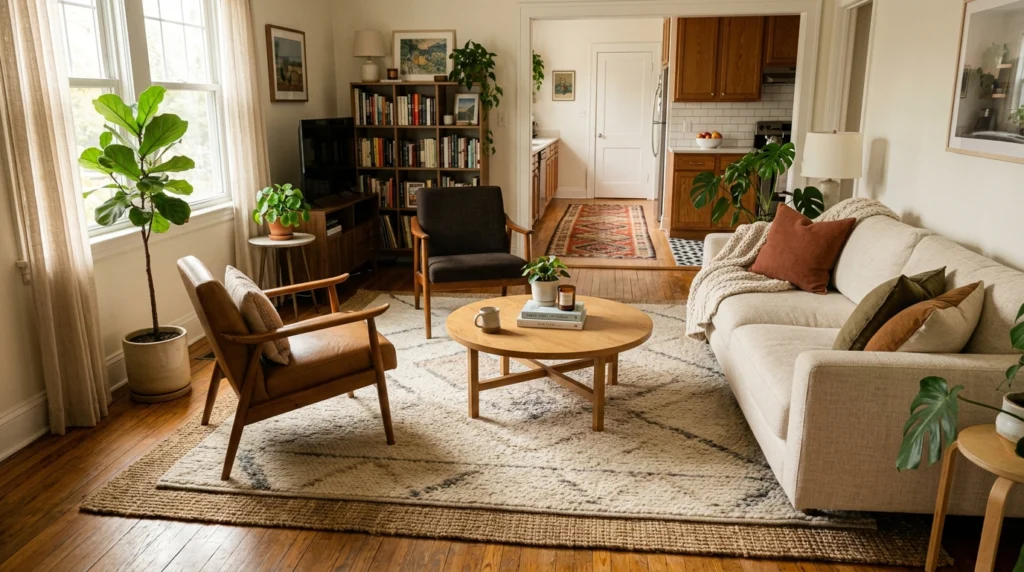
Rental floors are often the weakest visual element in the space — builder-grade carpet, dated vinyl, or scuffed laminate. Here’s how to deal with every floor type without permanent modifications.
Rugs: Your Most Powerful Floor Tool
A quality area rug is the most effective and completely renter-safe floor solution. It covers dated flooring, adds warmth, defines zones in open-plan spaces, and improves acoustics. For maximum impact:
- In living rooms: Choose an 8×10 or 9×12 rug — big enough to anchor all furniture. The front legs of every sofa and chair should sit on the rug.
- In bedrooms: A 5×8 centered under the bed (extending 18–24 inches on each side and at the foot) transforms the entire room.
- In dining rooms: The rug should extend at least 24 inches beyond every side of the table — chairs should remain on the rug even when pulled out.
- In kitchens: Runner rugs (2×6 or 2.5×8) define the cooking zone and add color to the most utilitarian room in the apartment.
Peel-and-Stick Flooring Tiles
For particularly bad rental floors — outdated vinyl, damaged linoleum — peel-and-stick floor tiles are a renter-safe option with an important caveat: check your lease first. Most leases allow them as long as the original floor is undamaged underneath. Use tiles designed for rental use with removable adhesive, not permanent adhesive tiles.
Best current options: LVP (luxury vinyl plank) peel-and-stick tiles, removable wood-look planks, and interlocking foam tiles in kitchen and bathroom areas.
Rug Pads: Non-Negotiable for Renters
A rug pad serves double duty for renters: it prevents the rug from slipping (a safety issue), and it protects the floor underneath from any texture or dye transfer from the rug. Never place a rug directly on hardwood or vinyl without a proper pad underneath.
5. Windows and Lighting: The Fastest Way to Change a Room’s Feel
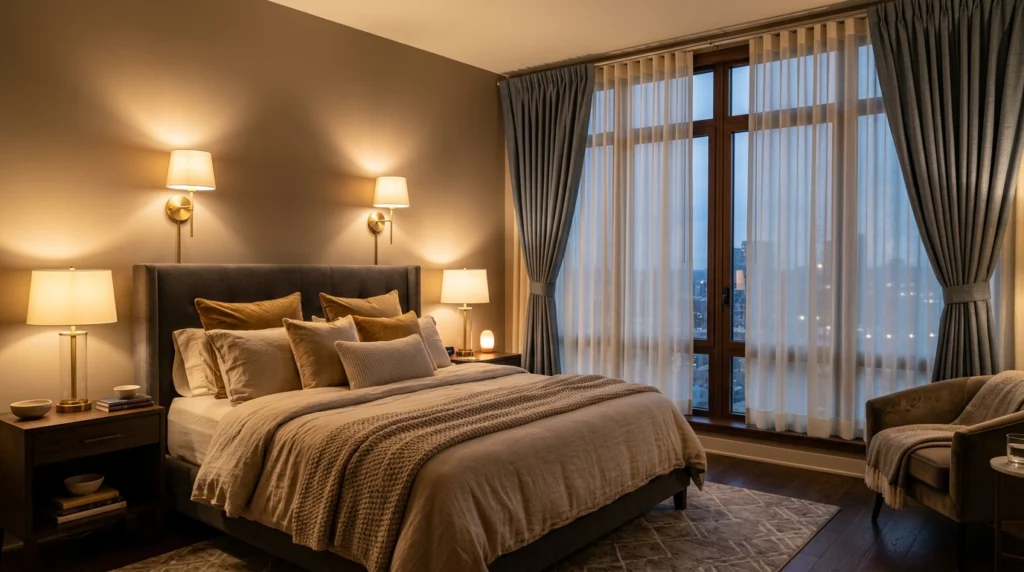
Lighting is arguably the element most renters neglect — and the one that makes the most immediate difference. Standard rental apartments have one overhead fixture per room and zero personality. Here’s how to fix both without touching the wiring.
No-Drill Curtain Rods
Tension rod curtain systems have improved dramatically. For windows up to 48 inches wide, a quality tension rod can hold medium-weight curtains without drilling. For wider windows or heavier drapes, use curtain rod brackets that use adhesive instead of screws — brands like STAS offer systems rated to 40+ lbs.
Curtain height and width tip: Hang curtains as high as possible (ideally at ceiling height) and as wide as possible (8–12 inches beyond the window frame on each side). This makes windows appear taller and wider — one of the most effective visual tricks in small apartments.
Layering Window Treatments
Sheer panels plus blackout curtains give you full light control: sheers for daytime diffusion, blackouts for nighttime privacy and sleep. This layered approach also adds depth and texture to a window — making it a styled focal point rather than a functional afterthought.
Plug-In Sconces and Swag Lighting
This is the most underused renter lighting trick. Plug-in wall sconces — lamps that plug into a standard outlet but mount on the wall like a hardsconce — eliminate the need for electrical work. Wrap the cord behind furniture or use a cord cover (paintable and removable) to create a clean look. A pair of plug-in sconces flanking a bed adds $150 of hotel-level ambiance for under $80 total.
Smart Bulbs in Existing Fixtures
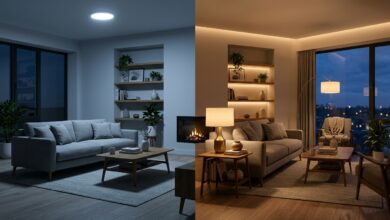
Every rental comes with existing light fixtures. Swap the bulbs for smart bulbs (Philips Hue, IKEA Tradfri, or Wyze) set to warm white (2700K) for evening use. The difference between a rental apartment lit at 5000K cool white and one lit at 2700K warm white is dramatic — it’s the difference between a hospital hallway and a cozy home. Cost: $10–$15 per bulb, and you take them with you when you move.
Floor Lamps and Table Lamps
Two floor lamps positioned in opposite corners of a living room eliminate the harsh central-fixture-only problem entirely. Add a table lamp on each side of a bed. Add a small lamp to any dark corner. Lamps are portable, require no installation, and are the single most effective lighting upgrade available to renters.
6. Furniture Strategies for Renters
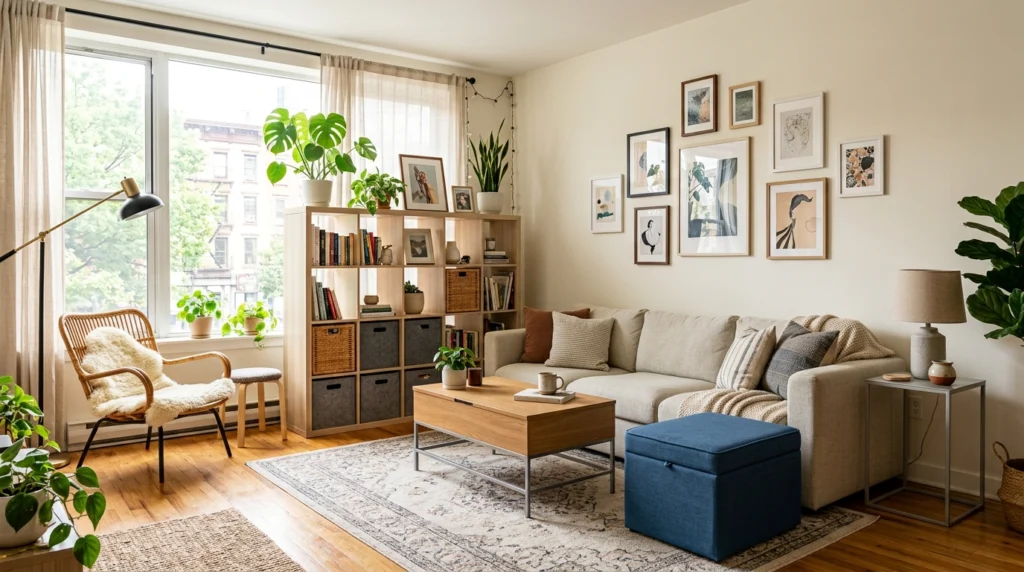
Renters move more frequently than homeowners — the average American renter moves every 2–3 years. That changes how you should think about furniture.
Buy for Portability
Heavy, oversized sectionals are a pain to move and often don’t fit in the next place. Modular sofas (like those from IKEA’s KIVIK or Article’s modular lines) can be reconfigured for different floor plans. Lightweight, well-made pieces that can be moved by two people without professional movers are the renter’s ideal.
Freestanding Storage Over Built-In
Don’t add to walls when you can add to floors. A freestanding bookshelf, a wardrobe, a media console — these give you storage and visual impact without any modification. The IKEA KALLAX cube shelving system has become a renter staple precisely because it’s modular, affordable, portable, and can be configured to fit almost any space.
Multi-Functional is Mandatory
Every piece you own in a rental should earn its floor space. An ottoman with storage, a dining table with leaf extensions, a daybed that doubles as a sofa, a desk that folds against the wall — these choices directly expand your usable space without expanding your square footage.
Second-Hand as a Strategy, Not a Compromise
For renters, second-hand furniture is a strategic choice. You spend less on pieces you may not be able to take to your next place, you get character and individuality that mass-market furniture can’t offer, and you can resell when you move. Facebook Marketplace, Craigslist, and OfferUp are the primary sources — budget $20–$200 for pieces that would cost $400–$2,000 retail.
Also Read: Modern Farmhouse Bedroom Decor Ideas:The Complete Guide to Cozy, Stylish Sleep Spaces (2026)
7. Room-by-Room Renter-Safe Decorating Checklist
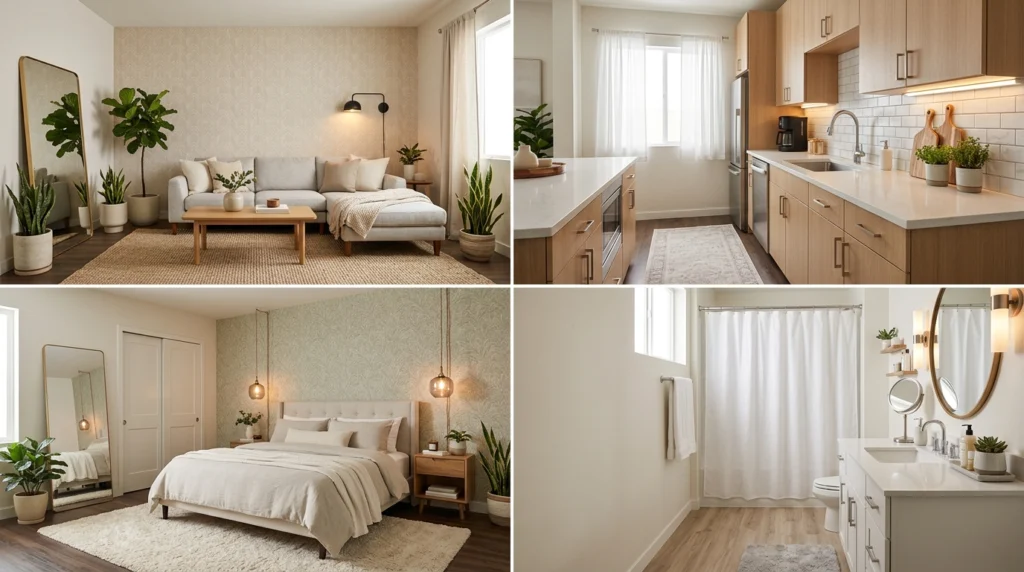
Living Room
- Large area rug anchoring the seating zone
- At least two portable lamps (floor or table) beyond the overhead fixture
- Gallery wall using adhesive strips — no nails
- Removable wallpaper or peel-and-stick tiles on one accent wall
- Leaning art or mirror rather than hanging (for anything over 10 lbs)
- Curtains hung at ceiling height on tension or adhesive rods
- Plants: at least one large statement plant or a cluster of smaller ones
- Throw blankets and textured pillows for seasonal updates
Bedroom
- Rug under the bed extending 18–24 inches on sides and foot
- Blackout curtains over sheer panels for full light control
- Plug-in bedside sconces OR table lamps on both nightstands
- 3-layer bedding method: fitted sheet + duvet + throw blanket at foot
- Full-length leaning mirror to add space
- Removable wallpaper on headboard wall as a feature
- Smart bulbs in existing fixtures set to 2700K warm white
- Storage ottoman or under-bed storage boxes for overflow
Kitchen
- Peel-and-stick backsplash behind stove (fully removable)
- Updated cabinet hardware (store originals in a labeled bag)
- Open canisters on the counter for dry goods — functional and decorative
- Runner rug in front of sink/prep area
- Removable shelf liner inside cabinets for color/texture
- Magnetic spice rack on refrigerator side panel
- Plants: pothos or herbs on the windowsill
Bathroom
- Adhesive mirror tiles or a frameless leaning mirror
- Real wood bath mat instead of standard terry cloth
- Matching white or linen towel set (eliminate visual chaos)
- Humidity-tolerant plants: pothos, snake plant, fern
- Peel-and-stick removable tiles on floor (check lease)
- Adhesive hooks for towels and robes (Command Outdoor line for damp areas)
- Tension rod shelf over toilet for extra storage
8. Budget Breakdown: Renter-Safe Decor at Every Price Point
| Budget Tier | What to Prioritize | Expected Impact |
|---|---|---|
| Under $50 | Smart bulbs (2 pack), throw pillow covers, a small plant, removable wall decals, and a rug pad for an existing rug | Lighting and small textile updates — immediate warmth improvement |
| $50–$150 | One area rug (smaller rooms), a floor lamp, peel-and-stick backsplash tiles for the kitchen, no-drill curtain hardware + curtains | The ‘this feels like a real home’ shift — worth prioritizing here |
| $150–$350 | Removable wallpaper for one accent wall, a large area rug for the living room, plug-in sconces for the bedroom, second-hand furniture refresh | Full room transformation in 1–2 spaces |
| $350–$600 | Multi-room refresh: living room rug + curtains + lamp + accent wall + bedroom sconces + kitchen hardware swap | Whole-apartment cohesion — feels intentional and designed |
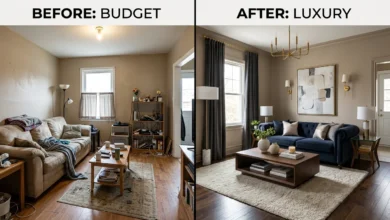
| $600+ | Statement furniture pieces (sofa, bed frame), quality area rugs throughout, full window treatment package, art collection on adhesive strips | Magazine-level results — rentership invisible to guests |
| ★ RENTER INVESTMENT STRATEGY Prioritize portable, take-with-you items over fixed improvements. A $300 area rug moves with you to your next apartment. A $300 built-in shelf does not. The best renter ROI order: Lamps → Rugs → Curtains → Removable wall treatment → Furniture. This is the inverse of what most renters do (furniture first). |
9. 2026 Trends That Are Perfectly Renter-Friendly
The good news for renters in 2026: the dominant design trends this year are almost entirely achievable without permanent modifications. Here’s what’s trending and how to implement each one safely.
| 2026 Trend | How Renters Can Achieve It |
|---|---|
| Modern Cottage: warm, layered, curved | Curved accent chairs + throw blankets + warm-toned removable wallpaper. No structural changes needed. |
| Plate wall displays replacing gallery walls | Adhesive plate hangers + command strips. Completely removable. One of the most renter-friendly trends in years. |
| Warm wood tones (walnut, honey oak) | Wood-finish contact paper on existing furniture. Wood-look LVP peel-and-stick tiles. Warm wood floor lamps and side tables. |
| Moody, saturated wall colors | Removable wallpaper in deep sage, forest green, deep burgundy. Or, ask your landlord — many allow repainting if you repaint back before leaving. |
| Art Deco revival (brass, velvet, geometry) | Brass plug-in sconces, velvet accent pillows, geometric removable wallpaper, brass cabinet hardware (store originals). |
| Antiques as focal pieces | Second-hand and vintage furniture is both on-trend and portable. A single vintage lamp or mirror elevates any rental instantly. |
10. The 6 Biggest Renter Decorating Mistakes
Mistake 1: Decorating Before Reading the Lease
Everything else on this list is secondary to this. Know what your lease allows. Some landlords are surprisingly flexible — but you need written permission, not an assumption.
Mistake 2: Using the Wrong Adhesive Products
Not all peel-and-stick products are equal. Dollar store command strips, off-brand removable wallpaper, and generic adhesive hooks often fail — either falling off or pulling paint when removed. Invest in quality products from established brands (3M Command, Tempaper, RoomMates). The $3 savings on a knockoff hook is not worth a $150 deposit deduction.
Mistake 3: Skipping the Rug
The most common reason rental living rooms look cold and unfinished: no rug, or a rug that’s too small. A properly sized rug is the foundation of any living room. It’s portable, renter-safe, and the single highest-impact purchase you can make.
Mistake 4: Ignoring Lighting Entirely
Relying solely on the overhead fixture that came with the rental is the aesthetic equivalent of leaving the walls bare. Two floor lamps, a couple of table lamps, and warm-toned smart bulbs transform any rental from institutional to inviting — and costs under $150 total.
Mistake 5: Removing Adhesive Products Incorrectly
Follow removal instructions precisely. Pull command strips straight down, slowly. Remove peel-and-stick wallpaper at 45 degrees, section by section, after warming with a hair dryer. Rushed removal is the primary cause of paint damage — not the product itself.
Mistake 6: Buying Furniture That Won’t Move
Giant sectionals, bed frames that require two people and tools to disassemble, bookshelves that are bolted together — these are homeowner furniture choices. As a renter who may move in 18 months, prioritize furniture that disassembles easily, fits in a standard elevator, and works in a range of floor plan shapes.
11. Frequently Asked Questions
Yes — with conditions. Quality peel-and-stick wallpaper from reputable brands removes cleanly when done correctly (peeled at 45 degrees, slowly). Always test in an inconspicuous area first, and always clean the wall surface with rubbing alcohol before application. Avoid using it on freshly painted walls (under 30 days old) or highly textured walls, where removal is more likely to cause damage
For items under 16 lbs, use large Command Picture Hanging Strips in pairs. For heavier items (up to 30 lbs), use multiple pairs of Velcro Industrial Strength strips. For anything heavier, leaning is the safest renter-safe option — a large mirror or canvas leaning against a wall looks intentional and styled, not temporary.
Many landlords will allow repainting if you agree to return the walls to the original color before moving out. Ask in writing, get written confirmation, and purchase a small can of the original paint color (ask the landlord for the brand and color code) so you can touch up at move-out. Never assume verbal permission is sufficient.
Removable wallpaper is the best option for a full accent wall transformation. For a subtler effect, a large leaning canvas or a grid of adhesive-mounted art prints achieves a similar visual result with even less commitment. Fabric panels hung from a tension rod across the wall is another fully reversible option.
For windows up to 48 inches wide, tension rod curtain systems work reliably. For wider windows or heavier curtains, use adhesive curtain rod brackets (available from brands like Umbra and STAS) rated to 40+ lbs. Another option: a ceiling-mounted curtain track using adhesive ceiling hooks — this actually looks more elegant than a standard rod.
Absolutely. Environmental psychology research consistently shows that your living environment directly affects your mood, stress levels, and productivity. You spend the majority of your non-work hours at home — that environment should support your wellbeing. Focus spending on portable items (lamps, rugs, curtains, art) that move with you, and your investment carries forward to every future home.
The most renter-safe solution is a large area rug, which covers dated flooring while remaining fully portable. For particularly bad flooring (cracked vinyl, stained carpet), peel-and-stick LVP tiles are an option — but check your lease first, and only use products designed with removable adhesive.
12. Conclusion: Your Rental Can Look Exactly Like the Home You Want
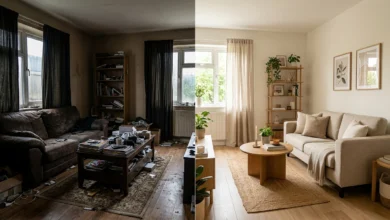
Renting doesn’t mean settling for a space that feels generic, cold, or temporary. With the right tools, the right products, and the right strategy, a rental can be just as warm, personal, and beautifully designed as any owned home — and you can take most of it with you when you leave.
The core principle: focus your investment on portable, reversible items. Lamps, rugs, curtains, plants, and removable wall treatments give you 90% of the visual impact of a full renovation at 10% of the cost and zero risk to your deposit.
Start with one room. Pick your focal point. Add a rug if you don’t have one. Swap your overhead bulbs for warm-toned smart bulbs. Add a floor lamp. Then step back and see the difference. You’ll wonder why you waited.
| ★ YOUR RENTER DECORATING ACTION PLAN Week 1: Read your lease. Photograph your space. Set your room-by-room budget. Week 2: Order smart bulbs and a rug pad. Swap bulbs to 2700K warm white today. Week 3: Source your anchor rug. Add a floor lamp to your living room. Week 4: Choose your accent wall treatment (removable wallpaper or leaned art). Month 2: Layer curtains, add plants, and swap cabinet hardware in the kitchen. Month 3: Fill in accessories, art, and the final 10% that makes it yours. |
Also Read: Complete Home Decor Guide: Styles, Tips, and Budget-Friendly Ideas for Every Room