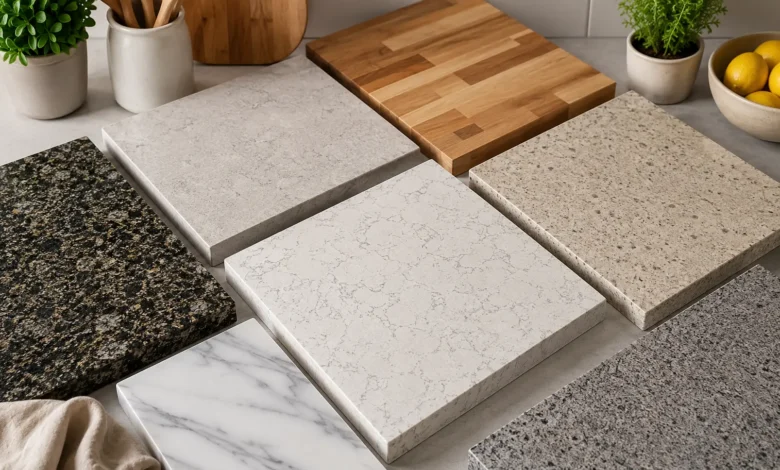
Countertops take more daily abuse than almost any other surface in the home — hot pans, knife slips, wine spills, and constant wiping down. They’re also one of the most visible design choices in the kitchen, which makes picking the right material a balancing act between looks, durability, maintenance, and cost. This guide compares the most popular kitchen countertop materials side by side, walks through installation and cost considerations, and covers standard countertop height, current trends, and ways to keep the counter organized once it’s in.
What to Weigh Before Choosing a Countertop Material
Before comparing specific materials, it helps to rank what matters most for your household, since no single material wins on every factor.
- Durability. How well the surface resists scratches, chips, and cracks under daily use.
- Heat resistance. Whether a hot pan straight off the stove can be set down safely.
- Stain resistance. How porous the material is, and whether spills like wine, coffee, or oil soak in if not wiped up quickly.
- Maintenance. Whether the surface needs regular sealing or special cleaners, or can be wiped down with anything.
- Cost. Material and installation costs vary widely, and premium materials aren’t always the most practical choice for every budget.
- Look and feel. Some materials, like natural stone, offer unique veining that can’t be replicated; others, like engineered quartz, offer more consistency and color control.
Matching the material to how the kitchen actually gets used matters more than chasing the most popular option. A household that bakes constantly and rolls out dough directly on the counter has different priorities than one that mostly reheats meals and rarely cooks from scratch.
Granite Countertops
Granite is a natural stone quarried in large slabs, prized for its durability and the fact that no two slabs look exactly alike.
Pros: Granite is highly heat resistant, so setting a hot pan directly on it is generally safe, and it resists scratching well enough to handle daily kitchen use without much worry. Because it’s a natural material, every slab has unique veining and coloring, which appeals to homeowners who want a one-of-a-kind counter.
Cons: Granite is porous and needs to be sealed periodically — typically once a year, though some sealants last longer — to resist staining from oil, wine, and other liquids. It’s also heavy, requiring proper structural support, and repairs to chips or cracks are more difficult than with engineered materials.
Best for: Households that want a natural stone look and don’t mind an annual sealing routine in exchange for strong heat and scratch resistance.
Quartz Countertops
Quartz countertops are engineered, made from crushed natural quartz combined with resins and pigments, which gives manufacturers control over color and pattern consistency that natural stone can’t offer.
Pros: Quartz is non-porous, so it doesn’t need sealing and resists staining significantly better than most natural stone. It’s also extremely durable against scratches and chips, and because it’s engineered, colors and patterns are far more consistent than natural stone slabs, which makes matching pieces across a large kitchen easier.
Cons: Quartz is not as heat resistant as granite — direct contact with a very hot pan can cause discoloration or damage, so trivets are recommended. It also tends to cost slightly more than mid-range granite, though pricing has become increasingly comparable in recent years.
Best for: Busy households that want durability and low maintenance without a sealing routine — quartz has become the most requested countertop material in many markets for exactly this reason.
Marble Countertops
Marble is a classic natural stone known for its distinctive veining, most commonly seen in white-and-gray variations like Carrara or Calacatta marble.
Pros: Marble offers a timeless, elegant look that’s hard to replicate with any engineered material, and it stays naturally cool, which makes it a favorite surface among bakers for rolling out dough and working with pastry.
Cons: Marble is soft and porous compared to granite or quartz, making it prone to staining, scratching, and etching (a dulling or discoloration that happens when acidic substances like lemon juice or wine contact the surface). It requires more frequent sealing and more careful daily use than most other countertop materials.
Best for: Households that value marble’s look enough to accept the extra care it requires, or those planning to use it selectively — for a baking station or an island rather than the entire kitchen.
Butcher Block (Wood) Countertops
Butcher block countertops are made from strips of wood, typically maple, walnut, or oak, glued together into a solid surface.
Pros: Butcher block brings warmth and a natural look that pairs well with a wide range of kitchen styles, and it can be sanded and refinished if it becomes scratched or worn over time, unlike stone or engineered surfaces.
Cons: Wood requires regular oiling to prevent drying, cracking, and water damage, and it’s more vulnerable to scratches, stains, and heat marks than stone. It’s generally not recommended directly around a sink or areas with constant water exposure unless properly sealed and maintained.
Best for: A single feature area, like an island or a baking zone, rather than the entire kitchen in most cases — though some households do choose full butcher block counters and accept the added maintenance.
Laminate Countertops
Laminate countertops are made by bonding a thin decorative layer to a particleboard or MDF core, and modern laminate has improved significantly in both appearance and durability compared to older versions.
Pros: Laminate is one of the most budget-friendly countertop options available, comes in an enormous range of colors and patterns (including convincing stone and wood looks), and installs quickly.
Cons: Laminate can chip at seams and edges over time, isn’t heat resistant (hot pans can scorch or discolor the surface), and can’t be repaired or refinished the way wood or stone can — damage typically means replacement.
Best for: Budget-conscious remodels, rental properties, and secondary kitchen spaces where a lower upfront cost matters more than long-term durability.
Concrete Countertops
Concrete countertops are custom-poured or precast, offering a distinctive, often industrial look that can be tinted, stamped, or embedded with decorative elements.
Pros: Concrete is highly customizable in shape, color, and texture, and when properly sealed, it’s very durable and heat resistant.
Cons: Concrete needs regular sealing to resist staining, and it can develop hairline cracks over time as it settles, which is a normal characteristic of the material rather than necessarily a defect. It’s also heavy and typically requires a longer lead time since most concrete counters are custom-made.
Best for: Modern or industrial-style kitchens where a customized, one-of-a-kind surface is a priority.
Stainless Steel Countertops
Stainless steel is most commonly associated with professional kitchens, though it’s increasingly used in residential kitchens for its clean, durable look.
Pros: Stainless steel is extremely durable, fully heat resistant, and non-porous, making it one of the most hygienic countertop options available. It doesn’t stain, crack, or require sealing.
Cons: It shows fingerprints, water spots, and scratches more visibly than most other materials, and it can dent under significant impact. The industrial look also doesn’t suit every kitchen style.
Best for: Professional-style kitchens, heavy-use households, or anyone prioritizing hygiene and durability over a softer, warmer aesthetic.
Solid Surface Countertops
Solid surface (a well-known brand being Corian) is an engineered material made from acrylic or polyester resins, offering a smooth, seamless look since seams can be bonded nearly invisibly.
Pros: Solid surface is non-porous, resists staining well, and can be sanded to remove minor scratches or burns, which sets it apart from most other engineered materials. It also allows for integrated sinks molded from the same material for a seamless look.
Cons: It’s less heat resistant than stone or quartz and can scorch from direct contact with hot cookware, and it doesn’t have the same premium look or resale appeal as natural stone in some markets.
Best for: Kitchens prioritizing a seamless look with an integrated sink, or households that want an easily repairable surface.
Quick Comparison: Countertop Materials at a Glance
| Material | Durability | Heat Resistance | Stain Resistance | Maintenance | Typical Cost | Best For |
|---|---|---|---|---|---|---|
| Granite | Very high | Excellent | Good (needs sealing) | Annual sealing | Mid to high | Natural stone look with strong durability |
| Quartz | Very high | Good (use trivets) | Excellent | Low, no sealing | Mid to high | Busy households wanting low upkeep |
| Marble | Moderate | Good | Poor (porous, etches) | High, frequent sealing | High | Elegant look, accent surfaces |
| Butcher block | Moderate | Poor | Moderate (needs oiling) | Regular oiling | Low to mid | Warm, natural islands and baking zones |
| Laminate | Moderate | Poor | Moderate | Low | Low | Budget remodels and rentals |
| Concrete | High | Excellent | Good (needs sealing) | Periodic sealing | Mid to high | Custom, industrial-style kitchens |
| Stainless steel | Very high | Excellent | Excellent | Low | High | Professional-style, heavy-use kitchens |
| Solid surface | Moderate to high | Poor to moderate | Excellent | Low | Mid | Seamless look with integrated sink |
This table is a starting point rather than a final answer — actual pricing and performance can vary by brand, thickness, and finish, so it’s worth confirming specifics with a local fabricator before deciding.
Also Read: Small Kitchen Design Ideas: How to Maximize Space in a Compact Kitchen
How Countertop Choice Affects the Rest of the Kitchen
Countertop material doesn’t exist in isolation — it interacts with cabinet color, backsplash choice, and even lighting in ways worth considering before finalizing a decision.
A busy, high-veining natural stone slab tends to look best against simpler cabinetry and a quieter backsplash, since a bold countertop paired with an equally bold backsplash can compete for attention rather than complement each other. Conversely, a more uniform, low-pattern quartz or laminate surface leaves more room for a statement backsplash or a bolder cabinet color without the kitchen feeling visually overloaded.
Lighting also affects how a countertop reads day to day — a glossy polished stone reflects more light and can help brighten a kitchen with limited natural light, while a matte or honed finish absorbs more light and can read as a calmer, more grounded surface in a bright, sunlit kitchen. Testing a countertop sample under the kitchen’s actual lighting, at different times of day, gives a much more accurate sense of the final look than viewing it under a showroom’s lighting alone.
There’s no single best kitchen countertop material for every household — the right choice depends on how the kitchen is used and what trade-offs matter most.
- For low maintenance and durability: Quartz is generally the top pick, since it resists stains without sealing and holds up well to daily use.
- For a natural stone look with strong durability: Granite remains one of the most balanced choices, offering excellent heat and scratch resistance in exchange for annual sealing.
- For the most elegant, timeless look: Marble is hard to beat, though it demands the most careful daily use of any common option.
- For budget-conscious remodels: Laminate delivers the widest range of looks at the lowest cost, with modern versions looking far better than older generations.
- For warmth and a natural material: Butcher block adds a look and feel no other material replicates, best used selectively if full-counter maintenance feels like too much.
Many kitchens today mix materials rather than choosing just one — quartz on the main perimeter counters with a butcher block or marble insert on the island, for example — to get the practical benefits of a low-maintenance surface with the character of a more distinctive one where it matters most.
Kitchen Countertop Ideas Worth Considering
Beyond the base material, a few design choices shape how the finished countertop looks and functions:
- Waterfall edges, where the countertop material wraps down the side of an island to the floor, have become one of the most requested kitchen countertop ideas for a high-end, seamless look.
- Mixed materials, such as a quartz perimeter with a wood or marble island, add visual interest and let each surface do the job it’s best suited for.
- Contrasting countertop and cabinet colors — a dark countertop against light cabinets, or vice versa — creates definition and depth that an all-matching kitchen can lack.
- Textured or honed finishes instead of high polish are gaining popularity, offering a softer look that also tends to show fingerprints and water spots less than a glossy polished surface.
- Integrated drainboards carved directly into stone or concrete near the sink add function without an extra accessory taking up counter space.
- Thicker edge profiles, like a bullnose or ogee edge, can make a standard-thickness slab look more substantial without paying for a thicker material throughout.
2026 Kitchen Countertop Trends
A few directions are showing up repeatedly in current kitchen design:
Warmer, earthier tones. Countertop colors are shifting away from stark white and gray toward warmer whites, soft beiges, and earthy taupe tones that pair well with the wood cabinetry and warm neutrals also trending in kitchen design right now.
Honed and matte finishes. A softer, non-reflective finish is increasingly popular over high-gloss polish, particularly on natural stone, offering a more understated look that also hides fingerprints and water spots better.
Bold veining as a focal point. Rather than choosing subtle, uniform patterns, many homeowners are selecting slabs with dramatic, high-contrast veining and treating the countertop as a statement feature rather than a background surface.
Sustainable and recycled materials. Countertops made from recycled glass, reclaimed wood, or engineered materials with a lower environmental footprint are gaining traction among homeowners prioritizing sustainability.
Thinner slabs paired with substantial-looking edges. Rather than using a full thick slab throughout (which is heavier and pricier), many fabricators are using a thinner slab with a built-up edge to achieve the same visual weight at a lower material cost.
Mixed-material kitchens. As mentioned above, combining two or more countertop materials in a single kitchen continues to grow, allowing durability where it’s needed most (perimeter counters) and character where it’s most visible (an island).
Kitchen Countertop Installation: What to Expect
Countertop installation timelines and steps vary somewhat by material, but the general process follows a similar pattern for most stone and engineered surfaces:
- Cabinet installation first. Countertops are measured and installed after cabinets are in place and level, since the counter needs an accurate base to sit on.
- Templating. A fabricator visits to take precise measurements — often using a digital template — of the cabinet layout, including cutouts for the sink, cooktop, and any outlets.
- Fabrication. The slab is cut, edges are finished, and any sink or cooktop cutouts are made at the fabricator’s shop. This step typically takes one to three weeks depending on the material and fabricator’s schedule.
- Installation day. The finished countertop is delivered and set into place, secured to the cabinets, and seams (if any) are bonded and polished. Installation itself for a standard kitchen usually takes a few hours to a full day.
- Sink and cooktop hookup. Plumbing and, if applicable, cooktop connections are completed after the countertop is set, since the cutouts need to align precisely with the fixtures.
- Sealing (if applicable). Porous materials like granite or marble may be sealed on-site as one of the final installation steps.
Also Read: Kitchen Cabinet Guide: Materials, Styles, and How to Choose the Right Fit
A few practical notes on installation: natural stone slabs should be viewed and approved in person (or via detailed photos) before fabrication, since color and veining vary significantly between individual slabs, even within the same stone type. It’s also worth confirming who is responsible for removing the old countertop and handling any plumbing disconnection, since these details are sometimes handled by a separate contractor rather than the countertop installer.
Kitchen Countertop Height and Standard Dimensions
Standard kitchen countertop height is 36 inches from the floor, which suits most adults for standing food prep without excessive bending or reaching. A few variations are common depending on how a section of counter is used:
- Standard counters: 36 inches high, 25 to 26 inches deep for base cabinets, which is the default for the majority of a kitchen’s counter space.
- Island seating (bar height): Often raised to 42 inches for a more casual, standing-height bar feel, typically paired with tall stools.
- Counter-height seating: 36 inches, matching the standard counter height, paired with standard counter-height stools — often preferred over bar height for easier, more comfortable seating.
- Baking or accessible-height sections: Some kitchens include a lower section, around 30 to 32 inches, either for rolling out dough more comfortably or to meet accessibility needs for seated food prep.
Countertop overhang also matters for seating comfort — a minimum of 12 inches of overhang is generally recommended to leave knee room for stools, and closer to 15 inches is more comfortable where the layout allows.
Kitchen Countertop Organizer Ideas
Keeping counters clear and organized matters as much as the material choice itself, since even the best countertop looks cluttered without a system for what lives on it.
- Corner organizers make use of the often-wasted counter space in a corner, holding small appliances like a coffee maker or toaster without taking up prime prep space.
- Under-cabinet storage racks mounted beneath upper cabinets can hold cutting boards, trays, or mugs, freeing up counter surface below.
- Utensil crocks and canisters keep frequently used tools within reach without a full drawer search, though it’s worth limiting these to a single spot rather than scattering several across the counter.
- Appliance garages — a cabinet or tambour-door unit that conceals a toaster, blender, or coffee station — keep small appliances accessible but out of sight when not in use.
- Tiered stands for fruit or frequently used pantry items add storage without spreading items across the full counter surface.
- Sink-area organizers, like a caddy for dish soap and sponges, keep the area around the sink from becoming a catch-all for miscellaneous items.
- A designated “landing zone” near the entry point to the kitchen — mail, keys, or takeout bags — keeps non-kitchen items from migrating onto the main prep counter.
The goal with countertop organization is generally to keep prep zones as clear as possible while giving frequently used items a specific, consistent spot, rather than letting the counter become general storage for anything without another home.
Countertop Maintenance by Material
- Granite and marble: Reseal on the schedule recommended by the manufacturer (often annually), wipe up spills — especially wine, oil, and acidic liquids — promptly, and avoid abrasive cleaners.
- Quartz: Wipe with mild soap and water; avoid high-heat exposure and harsh chemical cleaners that can dull the resin finish over time.
- Butcher block: Oil regularly (monthly is common for heavily used counters), sand out deep scratches periodically, and avoid letting water sit on the surface.
- Laminate: Clean with mild soap and water, avoid abrasive scrubbers that can dull the surface, and use a cutting board to prevent scratches, since laminate can’t be sanded out like wood.
- Concrete: Reseal periodically per the sealer manufacturer’s guidance, and address hairline cracks early if they appear, since they’re a normal part of the material’s aging process.
- Stainless steel: Wipe with a non-abrasive cleaner in the direction of the grain to avoid visible scratching, and use a stainless-specific polish occasionally to reduce fingerprint visibility.
Frequently Asked Questions
What is the most durable kitchen countertop material?
Quartz and granite are generally considered the most durable options for daily kitchen use, both resisting scratches and heat well. Quartz has the added advantage of being non-porous and not requiring sealing.
What is the best kitchen countertop material for a busy household?
Quartz is usually the top recommendation for busy households, since it combines strong stain and scratch resistance with low maintenance — no sealing required, unlike granite or marble.
How long does kitchen countertop installation take?
The templating-to-installation timeline typically runs one to three weeks depending on the material and fabricator’s schedule, with the actual installation day usually taking a few hours to a full day once the finished slab arrives.
What is the standard kitchen countertop height?
Standard kitchen countertop height is 36 inches from the floor. Islands used for casual bar-height seating are often raised to 42 inches, while some baking or accessible-use sections are lowered to around 30 to 32 inches.
Is marble a good choice for a kitchen countertop?
Marble offers a distinctive, elegant look but is more prone to staining, scratching, and etching than granite or quartz. It works well for households willing to maintain it carefully, or as an accent surface — like an island or baking station — rather than the entire kitchen.
How much does it cost to replace a kitchen countertop?
Costs vary significantly based on material, square footage, edge profile, and region. Laminate is typically the most affordable option, while natural stone and engineered surfaces like quartz sit in the mid-to-high range; getting itemized quotes from local fabricators is the most reliable way to estimate cost for a specific kitchen.
Do all countertop materials need to be sealed?
No. Porous natural stones like granite and marble need periodic sealing, along with concrete. Engineered materials like quartz, laminate, solid surface, and stainless steel do not require sealing.
Also Read: The Complete Kitchen Guide: Design, Layout, Appliances, and Care Tips for Every Home