Introduction
Most people try to clean their way out of a messy home, and most people end up frustrated by how little that actually accomplishes. You wipe the counter, but it’s covered in mail and half-used candles again within a day. You vacuum around a pile of shoes instead of moving it. You dust shelves crowded with things you don’t use and never quite finish. The missing step isn’t more elbow grease — it’s decluttering first.
Decluttering and cleaning are two different tasks that get treated as one, and that mix-up is the biggest reason cleaning routines stall out. Cleaning removes dirt, dust, and grime from a surface. Decluttering removes the excess items sitting on that surface in the first place. Skipping decluttering and going straight to cleaning means you’re constantly cleaning around things that shouldn’t be there, which takes longer, feels harder, and never quite results in the tidy home you’re aiming for.
This beginner’s guide walks through exactly how to declutter a home room by room, the mindset shifts that make the process easier, a realistic system for deciding what to keep, and guidance on when it might make sense to bring in decluttering services rather than tackling everything solo. By the end, you’ll have a clear, repeatable process you can use any time clutter starts creeping back in.
If you’ve tried decluttering before and found yourself putting most things back where they started, the process itself likely wasn’t the problem — a lack of a clear system usually is. Decluttering without a plan for where each item goes next tends to just shuffle mess around rather than actually reducing it. This guide gives you that missing structure, from the very first sorting decision to what to do with the boxes once a session is finished.
Why Decluttering Has to Come Before Cleaning
It’s tempting to skip straight to cleaning because it feels more immediately productive — spraying and wiping produces a visible, satisfying result right away. Decluttering, by comparison, can feel slower and more emotionally taxing, since it involves decisions rather than just motion. But the order matters for a few concrete reasons.
Cleaning Around Clutter Wastes Time
Every item sitting on a counter, floor, or shelf has to be picked up, moved, and put back down before you can actually clean the surface underneath it. Multiply that by every cluttered surface in a home, and decluttering first can cut total cleaning time significantly.
Clutter Hides Dirt and Makes Cleaning Less Effective
Dust settles on top of clutter, not just on open surfaces. A crowded shelf, a pile of papers, or an overstuffed drawer all trap dust and grime in places a quick wipe-down never reaches. Clearing the clutter exposes what actually needs cleaning.
A Cluttered Home Undermines Even a Perfect Cleaning Routine
You can follow every tip in a cleaning guide and still end up with a home that looks and feels chaotic if there’s simply too much stuff crowding every surface. Decluttering addresses the root cause; cleaning alone only manages the symptoms.
It Reduces the Mental Load of Maintaining a Home
Clutter isn’t just a visual problem — it adds a low-level cognitive burden, since your brain registers visual chaos even when you’re not actively looking at it. Homes with less clutter are generally easier to maintain because there’s simply less to manage, put away, and clean around.
The Decluttering Mindset: A Few Shifts That Make the Process Easier
Before diving into room-by-room steps, a few mindset shifts make decluttering feel far less overwhelming, especially for beginners.
You Don’t Have to Decide Everything at Once
Trying to make a final decision about every single item in one sitting is exhausting and often leads to decision fatigue, where you start keeping things just to avoid making more choices. Breaking decluttering into smaller sessions, room by room or even drawer by drawer, keeps decisions manageable.
“Might Need It Someday” Deserves a Second Look
Almost everyone has items kept for a hypothetical future use that never actually arrives. A helpful question: if this item disappeared today, would you go out and buy it again? If the honest answer is no, it’s a strong candidate to let go.
Sentimental Items Get Their Own Rules
Sentimental clutter is different from ordinary clutter and deserves a gentler process. Rather than forcing decisions on emotionally significant items during a general declutter, set them aside in a dedicated box and revisit them separately, without the pressure of an ongoing decluttering session.
Progress Matters More Than Perfection
A single drawer fully decluttered is real progress, even if the rest of the house isn’t touched yet. Aiming for steady, incremental progress rather than an all-or-nothing overhaul makes the process far more sustainable for beginners.
The Four-Box Method: A Simple System for Sorting
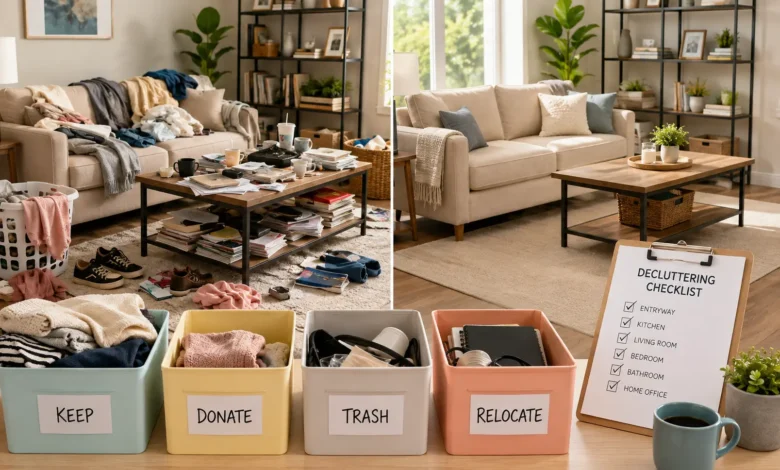
One of the most beginner-friendly approaches to decluttering is the four-box method, which gives every item a clear destination instead of leaving it in limbo.
- Keep — items you use regularly or that hold genuine value
- Donate — items in good condition that you no longer need but someone else could use
- Trash — items that are broken, expired, or no longer usable
- Relocate — items that belong in a different room and just ended up in the wrong place
As you work through each room, sort every item into one of these four categories rather than leaving anything in a vague “maybe” pile, which tends to become its own form of clutter. Commit to processing the donate and trash boxes immediately after each session — items left sitting in a donate box for months often quietly migrate back into the home.
Putting the Four-Box Method Into Practice
Set aside a specific time window for each session — even 30 minutes is enough to make real progress in a single drawer or shelf. Bring all four boxes (or bags, or bins, whatever’s on hand) into the space you’re working on, and resist the urge to leave the room mid-session to “deal with” an item elsewhere, since that’s often how sessions lose momentum. At the end of each session, immediately load the trash box into the outdoor bin and place the donate box by the door or directly in the car, so it leaves the house at the first opportunity rather than sitting around and inviting a change of heart.
How to Declutter a Home: A Room-by-Room Guide
Entryway
The entryway sets the tone for the rest of the home and tends to accumulate shoes, bags, mail, and miscellaneous items dropped in passing.
- Remove everything from the entryway surface, floor, and any nearby seating
- Sort using the four-box method
- Keep only what’s used daily — shoes currently in rotation, a small set of essentials
- Add a designated spot for mail so it doesn’t pile up on a console table
- Return only the “keep” items, arranged intentionally rather than dropped wherever there’s space
Because the entryway is the first thing you and any guests see, decluttering it tends to deliver an outsized sense of progress early in the process, which can help build momentum for the rest of the home.
Kitchen
Kitchens accumulate clutter quickly through duplicate tools, expired pantry items, and single-use gadgets that rarely get used.
- Empty one cabinet or drawer at a time rather than the whole kitchen at once
- Check expiration dates on pantry items and spices, discarding anything expired
- Consolidate duplicate tools — most kitchens only need one of each basic utensil
- Evaluate small appliances honestly: if something hasn’t been used in the past year, it’s a strong donate candidate
- Clear counters down to only what’s used daily, since a decluttered counter is one of the biggest visual differences in a kitchen
A fully decluttered kitchen, even before any deep cleaning happens, tends to look and feel noticeably more spacious — clear counters and organized cabinets make even an older or smaller kitchen feel more functional.
Also Read: How to Deep Clean Your Kitchen: A Step-by-Step Guide
Living Room
Living rooms often become a catch-all for items from every other part of the home — chargers, mail, toys, blankets, and books all tend to migrate here.
- Clear surfaces first: coffee tables, side tables, and any open shelving
- Sort books, media, and decor, keeping only what you genuinely use or display intentionally
- Relocate items that belong elsewhere in the home rather than letting them accumulate
- Reassess furniture that no longer fits the space or serves a clear purpose
Bedroom
Bedrooms often hide clutter inside closets and under the bed, even when the visible surfaces look relatively tidy.
- Start with the closet, since clothing is one of the most common sources of bedroom clutter
- Use the “would you buy it again today” test for clothing you haven’t worn in the past year
- Check under the bed and inside nightstands, which tend to become storage for forgotten items
- Clear nightstands and dressers down to a handful of daily essentials
Bathroom
Bathrooms accumulate expired products, duplicate items, and things kept “just in case” more than almost any other room.
- Check expiration dates on medications, sunscreen, and skincare products
- Consolidate duplicate items — most bathrooms don’t need three half-used bottles of the same product
- Clear counters of anything not used daily
- Sort through towels and linens, donating any that are excessive or worn out
Home Office or Workspace
Paper clutter accumulates faster in a home office than almost anywhere else, along with outdated technology and office supplies.
- Sort through paper piles, shredding or recycling anything outdated
- Set up a simple filing system for documents you genuinely need to keep
- Consolidate office supplies, since duplicates are common here
- Evaluate old electronics and cables for donation or responsible recycling
A home office that’s been properly decluttered often reveals just how much unnecessary paper and outdated equipment had been quietly accumulating, sometimes for years without anyone noticing how much space it was taking up.
What to Do With Sentimental Clutter
Sentimental items deserve a different process than the rest of a home’s clutter, since they carry emotional weight that ordinary items don’t.
- Set a dedicated container for sentimental items rather than letting them spread across the home
- Photograph items you’re unsure about before deciding, which preserves the memory without requiring you to keep the physical object
- Give yourself permission to keep a reasonable amount, rather than aiming for zero sentimental items — the goal is intentional curation, not elimination
- Revisit the sentimental box periodically, since feelings about certain items can shift over time, making it easier to let go of some later than it would have been in the moment
Keeping Clutter From Coming Back
Decluttering once is only half the work — the other half is preventing clutter from rebuilding at the same pace it did before.
The One-In, One-Out Rule
For categories prone to accumulation, like clothing or kitchen gadgets, consider letting go of one similar item each time you bring a new one in. This keeps overall volume steady rather than growing indefinitely.
A Weekly Reset
Spend 10–15 minutes each week doing a quick pass through common problem areas — the entryway, kitchen counters, coffee table — putting stray items back where they belong before clutter has a chance to build up.
Designated Homes for Everything
Clutter often accumulates simply because an item doesn’t have an obvious “home” to return to. Assigning a specific spot for frequently used items — keys, mail, chargers — makes it far easier to keep them from spreading across the house.
Reassess Seasonally
A quick seasonal check-in, alongside your regular cleaning schedule, helps catch clutter that’s crept back in before it becomes overwhelming again.
Involving the Whole Household in Decluttering
Decluttering rarely stays effective long-term if only one household member handles it while everyone else continues accumulating at the same pace. A few approaches help spread the responsibility more evenly.
Set Shared Expectations
Have a brief conversation with everyone in the household about the goal — a tidier, easier-to-maintain home — rather than framing decluttering as one person’s personal project. Shared buy-in makes the results far more likely to last.
Give Kids Age-Appropriate Ownership
Children can take part in decluttering their own belongings with guidance rather than having everything decided for them. Even young children can sort toys into “keep” and “donate” piles with a parent’s help, which also introduces the habit early.
Respect Different Attachment Levels
Not everyone in a household will feel the same way about the same items. A partner’s collection or a family member’s keepsakes may carry more emotional weight to them than they do to you, and pushing too hard on someone else’s belongings often creates friction without actually helping. Focus your own decluttering efforts on shared and personal spaces, and let others lead the process for their own things.
Also Read: How to Build a Weekly and Monthly Cleaning Schedule That Actually Sticks
When to Consider Hiring Decluttering Services
For some households, a DIY approach to decluttering isn’t realistic, whether due to time constraints, the emotional weight of certain situations, or simply the scale of clutter that’s built up over years. This is where professional decluttering services can genuinely help.
Situations Where Decluttering Services Make Sense
- Major life transitions — downsizing, moving, or settling an estate often come with more decisions and more volume than a typical weekend can handle
- Chronic clutter buildup — when clutter has accumulated over years and feels too overwhelming to face alone
- Time constraints — busy households, especially those juggling work and caregiving, may simply not have the hours a full declutter requires
- Emotional difficulty — situations involving hoarding tendencies or grief-related clutter often benefit from a professional’s neutral, non-judgmental support
- Preparing a home to sell — decluttering services are commonly used to prepare a home for staging and showings, since a decluttered space tends to show significantly better to potential buyers
What Decluttering Services Typically Offer
Most decluttering services provide hands-on sorting help, guidance on donation and disposal logistics, and sometimes organizational systems to help maintain the results afterward. Some overlap with professional organizing services, offering follow-up sessions to help a household maintain the changes over time rather than a single one-time visit.
What to Look for When Hiring Decluttering Services
- Clear communication about their process and how decisions about items are handled
- A judgment-free, patient approach, particularly important for sentimental or emotionally difficult clutter
- Transparent pricing, since sessions are often billed hourly and total cost can vary significantly based on the scope of work
- Experience with your specific situation, whether that’s downsizing, estate clearing, or general household decluttering
Even if you ultimately choose to declutter on your own, professional decluttering services remain a reasonable option to keep in mind for situations that feel too large, too emotionally complex, or too time-consuming to handle without support.
What a Typical Decluttering Services Session Looks Like
Most professional decluttering services begin with an initial consultation, either in person or virtually, to assess the scope of the space and discuss goals and any specific concerns, such as sentimental items or a tight timeline. From there, sessions are usually scheduled in blocks of a few hours, during which the professional works alongside you (rather than doing everything independently) to sort items, make decisions, and organize what remains. Pricing typically reflects the hourly rate of the service plus the scale of the project, and many services offer a free or low-cost initial consultation to provide a more accurate estimate before committing to a full package.
For households unsure whether a full service is necessary, some decluttering services also offer smaller, single-room sessions, which can be a lower-commitment way to test whether professional support is worth the investment for a larger project later on.
Common Decluttering Mistakes to Avoid
- Starting with sentimental items first. These are the hardest decisions to make, and starting here often causes decluttering momentum to stall before it begins. Start with easier categories instead.
- Buying storage solutions before decluttering. Organizing clutter into bins doesn’t reduce it — it just makes it look tidier temporarily. Declutter first, then organize what remains.
- Keeping the “maybe” pile indefinitely. A maybe pile that never gets revisited becomes permanent clutter by default.
- Trying to declutter the entire home in one day. This leads to burnout and half-finished rooms. Smaller, focused sessions produce better and more lasting results.
- Skipping the follow-through on donate and trash items. Bags left sitting by the door for weeks often quietly get unpacked again.
- Decluttering without a plan for where things go next. Removing an item without deciding whether it’s trash, donation, or belongs elsewhere just moves the clutter rather than resolving it.
Frequently Asked Questions
Why should I declutter before cleaning instead of at the same time? Cleaning around clutter takes longer and misses dust and grime hidden underneath items that shouldn’t be there in the first place. Decluttering first clears the surface so cleaning can be faster and more thorough.
How long does decluttering an entire home typically take? This varies widely based on how much clutter has accumulated and how much time you can dedicate each session, but breaking the process into room-by-room sessions of an hour or two, spread across several weekends, is realistic for most households rather than trying to complete everything at once.
What’s the best way to decide what to keep? The “would you buy it again today” test works well for most categories: if you wouldn’t purchase the item again if you saw it in a store, it’s a strong candidate to let go. Usage frequency is another reliable guide — items unused in the past year are worth reconsidering.
Is it worth hiring decluttering services instead of doing it myself? For households facing major life transitions, chronic clutter buildup, or significant time constraints, decluttering services can provide meaningful support, both practically and emotionally. For more routine, moderate clutter, a DIY approach using the room-by-room method in this guide is often sufficient.
How do I stop clutter from coming back after decluttering? Assign a specific home for frequently used items, adopt a one-in-one-out approach for categories prone to accumulation, and build a short weekly reset into your existing routine to catch stray items before they pile up again.
What should I do with sentimental items I’m not ready to part with? Set them aside in a dedicated container rather than forcing a decision immediately. Photographing items you’re unsure about can also help preserve the memory without requiring you to keep the physical object indefinitely.
How Decluttering Fits Into Your Broader Cleaning Routine
Once a space has been decluttered, it’s worth connecting that work to an ongoing cleaning routine so the results actually last. A decluttered home still needs regular maintenance — dusting, vacuuming, wiping surfaces — but that maintenance becomes noticeably faster and easier once there’s less to clean around. Many households find that a full decluttering pass, followed by establishing a consistent weekly and monthly cleaning schedule, produces a home that’s dramatically easier to keep tidy than either step accomplishes on its own. Decluttering clears the excess; a steady cleaning routine keeps the remaining space consistently maintained, and the two work best as a pair rather than as one-time, disconnected efforts.
Also Read: How to Remove Common Household Stains From Carpet, Fabric, and Upholstery
Final Thoughts
Decluttering before cleaning isn’t an extra step — it’s the step that makes every cleaning routine actually work the way it’s supposed to. A home with less clutter is easier to clean, easier to maintain, and genuinely lighter to live in day to day. Start small, use a simple system like the four-box method, and build the habit of returning to problem areas regularly so clutter never gets the chance to pile back up to where it started.
For most beginners, the hardest part isn’t learning the process — it’s starting the first session. Pick one small area, set a timer for 20 or 30 minutes, and treat that single session as the whole goal for the day. The habit and the momentum tend to build naturally from there, and before long, a decluttered home stops feeling like an ongoing project and starts feeling like simply how your home is.
For the full cleaning routine this guide fits into, see The Complete House Cleaning Guide for room-by-room techniques and schedules across your entire home.