Introduction
Bathrooms combine everything that makes a room hard to keep clean: constant moisture, soap residue, hard water, and daily bacteria exposure, all in a relatively small space. It’s no surprise that bathroom cleaning tends to get put off longer than almost any other household chore, even though a neglected bathroom shows dirt, grime, and mold faster than most other rooms in a home.
This guide is built as a complete bathroom cleaning checklist — covering every surface from the toilet to the tile grout, the tools and bathroom cleaning products worth having on hand, and a realistic schedule so you’re not scrubbing the same buildup every single week. You’ll also find guidance on choosing the best bathroom cleaning products for different surfaces, when a bathroom cleaning service might be worth considering, and answers to the questions people search most often when trying to get their bathroom truly clean.
Whether you’re setting up a bathroom cleaning routine for the first time or trying to fix one that keeps falling behind, this checklist gives you a clear, repeatable system to follow.
Most bathroom cleaning frustration doesn’t come from a lack of effort — it comes from an inconsistent routine, the wrong products for a given surface, or tackling tasks in an order that wastes time. This guide addresses all three, so the next time you clean your bathroom, it actually stays clean longer than a day or two.
Why Bathrooms Get Dirty So Fast
Understanding why bathrooms accumulate grime quickly makes it easier to stay ahead of it, rather than constantly playing catch-up.
Moisture Everywhere
Showers, sinks, and toilets introduce constant moisture into a relatively enclosed space, creating ideal conditions for mold and mildew to develop, particularly in grout lines and around caulking where ventilation is weakest.
Soap Scum and Hard Water
Soap residue combines with minerals in hard water to form a filmy buildup on tile, glass, and fixtures. Left untreated, this buildup hardens and becomes significantly more difficult to remove than if it’s addressed regularly.
High Bacteria Exposure
Between the toilet, sink, and shower drain, bathrooms host more bacteria per square foot than most other rooms in a home, which is why regular bathroom cleaning matters as much for hygiene as it does for appearance.
Small, Enclosed Space
Limited ventilation in many bathrooms means moisture lingers longer than it would in a larger, more open room, which accelerates mold growth and buildup on surfaces.
Frequent Contact With Products and Residue
Shampoo, conditioner, shaving cream, and toothpaste all leave behind residue on surfaces throughout the day. Individually, these seem minor, but they add up quickly in a space used multiple times daily by every household member, which is part of why bathroom cleaning needs more frequent attention than many other rooms.
Multiple Users, Multiplied Wear
A bathroom shared by several household members sees proportionally more use than almost any other room relative to its size, which means buildup, moisture, and general wear accumulate faster than in a similarly sized bedroom or living space. Households with more than one or two people sharing a bathroom often benefit from shifting daily wipe-downs from optional to routine, simply because the volume of use makes buildup happen noticeably faster.
Also Read: How to Build a Weekly and Monthly Cleaning Schedule That Actually Sticks
Building a Bathroom Cleaning Toolkit
Having the right tools and products on hand makes bathroom cleaning significantly faster and more effective. Here’s a complete list to build from.
Essential Tools
- A sturdy bathroom cleaning brush for the toilet bowl
- A separate scrub brush or grout brush for tile and grout lines
- A squeegee for glass shower doors and mirrors
- Microfiber cloths (at least a few, since you’ll want clean ones for different surfaces)
- Rubber gloves
- An old toothbrush for tight corners and fixtures
- A mop specifically used for the bathroom floor, kept separate from other household mops
Essential Bathroom Cleaning Products
- A toilet bowl cleaner
- An all-purpose bathroom cleaner or disinfectant spray
- A glass and mirror cleaner
- A tile and grout cleaner
- A mold and mildew remover
- Baking soda and white vinegar for natural alternatives
- A limescale or hard water stain remover, particularly useful in areas with hard water
Having a dedicated bathroom cleaning brush, rather than sharing one between the toilet and other surfaces, is a small detail that matters — cross-contaminating tools between the toilet and the rest of the bathroom spreads bacteria rather than removing it.
Choosing the Right Bathroom Cleaning Brush
Not all bathroom cleaning brushes are built for the same job, and having the right one for each surface makes a noticeable difference in results:
- A toilet bowl brush with stiff, angled bristles reaches under the rim and into the trap effectively
- A grout brush, often with a smaller head and dense bristles, gets into narrow grout lines that a standard scrub brush can’t reach
- A soft-bristled brush works well for tile, tub, and sink surfaces where you want cleaning power without risking scratches
- A brush with a long handle is useful for reaching the back of the tub or shower without excessive bending
Replacing bathroom cleaning brushes every few months, or sooner if bristles start to fray, keeps them working effectively rather than just pushing grime around.
Choosing the Best Bathroom Cleaning Products for Your Surfaces
Not every product works well on every surface, and using the wrong one can either underperform or, in some cases, damage the material.
For Toilets
A thick-gel toilet bowl cleaner that clings to the inside of the bowl gives the product more contact time to break down stains and buildup before scrubbing.
For Tile and Grout
A dedicated tile and grout cleaner, or a baking soda paste for a natural alternative, handles buildup in grout lines more effectively than an all-purpose spray, since grout is porous and holds onto grime differently than a smooth surface.
For Glass Shower Doors and Mirrors
A dedicated glass cleaner or a vinegar-water solution applied with a squeegee prevents the streaking that a general all-purpose cleaner often leaves behind on glass.
For Chrome and Stainless Fixtures
A gentle, non-abrasive cleaner preserves the finish on faucets and showerheads. Vinegar works well for dissolving mineral buildup on these fixtures but should be rinsed off promptly to avoid dulling the finish over time.
For Natural Stone (Marble, Granite Countertops)
A pH-neutral stone cleaner is essential here, since acidic cleaners like vinegar and many general bathroom cleaners can etch and permanently dull natural stone surfaces.
The best bathroom cleaning products for your specific bathroom ultimately depend on what surfaces you have — a bathroom with natural stone counters needs a different approach than one with laminate or cultured marble.
Choosing Bathroom Cleaning Products for Sensitive Households
If anyone in your household has allergies, asthma, or sensitivity to strong fragrances, look for fragrance-free or low-VOC bathroom cleaning products, and avoid aerosol sprays where possible, since fine airborne particles can trigger coughing or irritation in enclosed bathroom spaces. Households with young children or pets may also want to prioritize non-toxic formulas, particularly for surfaces like the bathtub that come into direct, prolonged contact with skin.
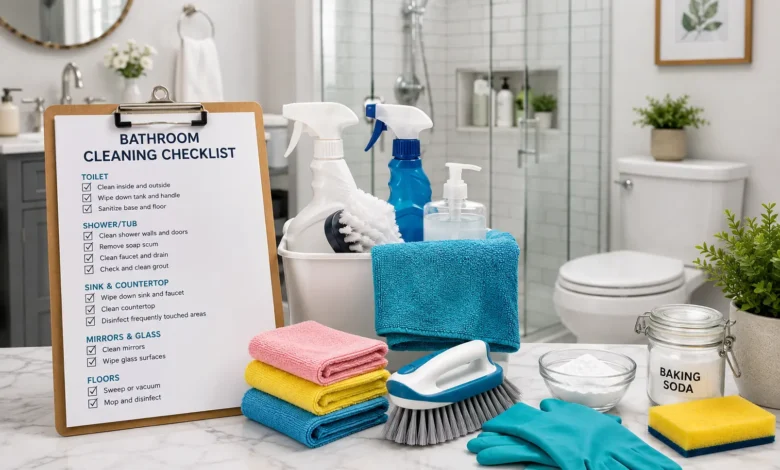
The Complete Bathroom Cleaning Checklist
Use this checklist as your core bathroom cleaning routine, moving through the space in a logical order that avoids re-cleaning surfaces you’ve already finished. Print it, save it to your phone, or simply use it as a mental walkthrough the next time you clean — the order matters as much as the individual tasks, since starting with the toilet and shower gives cleaning products time to work while you move on to other areas.
Step 1: Clear and Prep
- [ ] Remove items from counters, tub edges, and shower shelves
- [ ] Gather all tools and products before starting
Step 2: Toilet
- [ ] Apply toilet bowl cleaner and let it sit while working on other tasks
- [ ] Wipe down the exterior, base, and handle with an all-purpose or disinfectant cleaner
- [ ] Scrub the bowl with your bathroom cleaning brush and flush
Step 3: Shower and Tub
- [ ] Spray shower walls and tub with cleaner and let sit for a few minutes
- [ ] Scrub tile, tub surfaces, and grout lines with a scrub brush
- [ ] Clean the showerhead, removing mineral buildup with a vinegar soak if needed
- [ ] Squeegee glass doors to prevent water spots
Step 4: Sink and Counter
- [ ] Clean the sink basin and faucet
- [ ] Wipe down the counter
- [ ] Clean the mirror with a glass cleaner
Step 5: Floor
- [ ] Sweep or vacuum the floor
- [ ] Mop with a bathroom-specific cleaner suited to your flooring
Step 6: Finishing Touches
- [ ] Empty the trash bin
- [ ] Replace hand towels and bath mats
- [ ] Restock toilet paper and soap
- [ ] Wipe down light switches and door handles
Following this order — toilet and shower first, since they need the longest product contact time, then sink, then floor — keeps the whole session efficient rather than backtracking between surfaces.
Also Read: Natural Cleaning Recipes: DIY Solutions for a Chemical-Free Home
How Often Should You Clean Each Part of the Bathroom?
Not every bathroom cleaning task needs the same frequency. Spreading tasks across a realistic schedule prevents both neglect and burnout.
Daily
- Wipe the sink and counter after use
- Squeegee glass shower doors or wipe down the tub
Weekly
- Full toilet cleaning
- Shower and tub scrub
- Mirror and glass cleaning
- Floor sweep and mop
- Wash bath mats and hand towels
Monthly
- Deep clean grout lines
- Clean the exhaust fan cover
- Descale the showerhead and faucet aerator
- Wipe down cabinet fronts and drawer pulls
Seasonal
- Wash the shower curtain or liner
- Check caulking for mold and address as needed
- Clean behind the toilet and around fixture bases
- Deep clean cabinet interiors
Preventing Mold and Mildew Between Deep Cleans
Since bathrooms are especially prone to mold, a few daily and weekly habits go a long way toward reducing buildup between full cleaning sessions.
- Run the exhaust fan during and for 15–20 minutes after every shower
- Leave the shower curtain or door slightly open so surfaces can air-dry rather than staying sealed and damp
- Wipe down glass and tile after showering if time allows, which prevents soap scum from setting
- Address any small mold spots on caulking immediately, rather than waiting for a deep clean, since mold spreads quickly in a consistently damp environment
- Keep bath mats and towels dry between uses rather than leaving them bunched on the floor
Why Ventilation Matters More Than Most People Realize
Of all the habits listed above, running the exhaust fan consistently has the single biggest impact on long-term mold prevention. A bathroom that vents moisture properly after every shower can go significantly longer between deep grout and caulking treatments than one that doesn’t, simply because mold needs sustained moisture to establish itself. If your bathroom doesn’t have a working exhaust fan, even cracking a window during and after showers makes a meaningful difference.
Natural Bathroom Cleaning Recipes
For households that prefer to limit synthetic chemical products, a few natural alternatives handle most bathroom cleaning tasks effectively, using ingredients most kitchens already have on hand. These recipes work particularly well for regular weekly maintenance, though a registered disinfectant is still worth keeping on hand for situations that call for stronger antibacterial protection, such as illness in the household.
Toilet Bowl Cleaner
Pour half a cup of baking soda into the bowl, followed by a cup of white vinegar. Let it fizz for 10 minutes, scrub with a toilet brush, and flush.
Shower and Tub Scrub
Mix baking soda with a small amount of castile soap into a paste, apply with a sponge, scrub, and rinse thoroughly.
Grout Cleaner
Combine baking soda with just enough water to form a paste, apply with an old toothbrush, let sit for 10 minutes, then scrub and rinse.
Glass and Mirror Cleaner
Combine equal parts water and white vinegar in a spray bottle for a streak-free finish on glass and mirrors.
When to Consider a Bathroom Cleaning Service
A regular DIY bathroom cleaning routine works well for most households, but there are situations where hiring a bathroom cleaning service, or a broader house cleaning service that includes bathrooms, makes practical sense.
Situations Where a Bathroom Cleaning Service Helps
- Limited time or a demanding schedule — busy households may simply not have the hours a thorough weekly clean requires
- Move-in or move-out cleaning — a deep clean before or after a move often benefits from professional equipment and expertise, especially for bathrooms that haven’t been maintained consistently
- Ongoing maintenance for larger households — homes with multiple bathrooms or larger families may find a recurring bathroom cleaning service more manageable than handling everything solo
- Stubborn buildup — heavy limescale, deeply set grout stains, or long-neglected mold sometimes respond better to professional-grade equipment and products
- Preparing for guests or special occasions — a one-time deep clean from a professional service before hosting can take the pressure off an already busy schedule
What Bathroom Cleaning Services Typically Include
Most bathroom cleaning services cover toilet, tub, shower, sink, mirror, and floor cleaning as standard, with add-on options like grout deep cleaning, cabinet interiors, or descaling available depending on the provider. Recurring services — weekly, biweekly, or monthly — are common for households that want ongoing maintenance rather than a single deep clean.
Finding Bathroom Cleaning Services Near Me
When searching for bathroom cleaning services near you, a few factors are worth comparing across providers: whether they bring their own supplies or use yours, their pricing structure (flat rate versus hourly), reviews from other local customers, and whether they offer a satisfaction guarantee. Many cleaning companies also offer a free initial quote, which makes it easy to compare a few local options before committing to a recurring service.
Questions to Ask Before Hiring a Bathroom Cleaning Service
- Do they bring their own bathroom cleaning products and tools, or is that the household’s responsibility?
- Is pricing based on a flat rate per visit or an hourly rate, and how is that determined for larger bathrooms or multiple bathrooms?
- What’s included in a standard visit versus what counts as an add-on, such as grout deep cleaning or cabinet interiors?
- Are they insured and bonded, which matters for liability if anything is damaged during a cleaning visit?
- Do they offer recurring scheduling discounts for weekly, biweekly, or monthly service compared to one-time cleanings?
Asking these questions upfront, whether you’re comparing a few bathroom cleaning services near you or a single provider, helps avoid surprises in cost or scope once the service begins.
Common Bathroom Cleaning Mistakes to Avoid
- Using the same brush for the toilet and other surfaces. This spreads bacteria rather than removing it — always keep toilet tools separate.
- Skipping ventilation. Cleaning without running the exhaust fan traps moisture and cleaning fumes, slowing drying and encouraging mold.
- Using acidic cleaners on natural stone. Vinegar and many general bathroom cleaners can etch and dull marble or granite over time.
- Ignoring the exhaust fan cover. Dust buildup here reduces ventilation efficiency, which indirectly worsens moisture and mold problems.
- Letting products sit too long without rinsing. Some cleaners, particularly bleach-based ones, can damage grout or fixtures if left far longer than the label recommends.
- Not addressing small mold spots early. A small patch on caulking is far easier to handle than mold that’s had months to spread.
- Overlooking the bath mat. A damp bath mat left on the floor between uses becomes a breeding ground for bacteria and mildew almost as quickly as the shower itself, yet it’s one of the most commonly forgotten items in a bathroom cleaning routine.
- Using too much product. More cleaner doesn’t mean more clean — excess product often leaves a residue that attracts dust and requires additional rinsing to fully remove.
- Neglecting the area around the toilet base. This spot is easy to overlook during a quick clean but tends to collect dust, hair, and grime that becomes far more noticeable and harder to remove the longer it’s ignored.
Frequently Asked Questions
What should be on a basic bathroom cleaning checklist?
A solid checklist covers the toilet, shower and tub, sink and counter, mirror, and floor, along with restocking essentials like toilet paper and soap. Working from surfaces that need the longest product contact time (toilet, shower) to those that need less (sink, floor) keeps the process efficient.
What are the best bathroom cleaning products for a beginner to start with?
A toilet bowl cleaner, an all-purpose disinfectant spray, a glass cleaner, and baking soda with white vinegar for natural alternatives cover nearly every basic bathroom cleaning need without requiring a large product collection.
How often should a bathroom really be cleaned?
A full weekly clean covering the toilet, shower, sink, and floor is standard for most households, with daily quick wipe-downs of the sink and shower glass to prevent buildup between full cleans, and monthly attention to grout, exhaust fans, and fixtures.
Is it worth hiring a bathroom cleaning service?
It depends on your time, household size, and how much buildup has accumulated. Busy households, larger homes with multiple bathrooms, or situations involving a move often benefit from professional help, while a consistent DIY routine works well for most everyday maintenance.
What’s the best tool for scrubbing grout?
A dedicated grout brush, or an old toothbrush for tighter spaces, paired with a baking soda paste or a dedicated grout cleaner, handles most grout buildup effectively without needing harsh scrubbing that could damage the grout lines.
How do I remove hard water stains from bathroom fixtures?
Soak a cloth in white vinegar and wrap it around affected fixtures for 15–20 minutes, then wipe clean. For showerheads, soaking the head directly in a vinegar solution dissolves mineral buildup effectively.
Can natural cleaning products fully replace commercial bathroom cleaners?
For most everyday cleaning tasks, yes — baking soda, vinegar, and castile soap handle soap scum, general grime, and light disinfecting well. For situations requiring stronger disinfection, such as illness in the household, a registered disinfectant product is still the more reliable choice.
How long does a full bathroom cleaning session typically take?
For an average bathroom, following the checklist in this guide typically takes 30–45 minutes for a well-maintained space, or up to 90 minutes if grout, mold, or hard water buildup have gone unaddressed for a while.
What’s the difference between bathroom cleaning services and a general house cleaning service?
A bathroom cleaning service typically focuses specifically on bathroom surfaces, sometimes with more specialized attention to grout, mold, and fixtures, while a general house cleaning service usually includes the bathroom as one part of a broader whole-home cleaning visit. Households with a single problem bathroom sometimes prefer a specialized service, while those wanting ongoing whole-home maintenance often choose a general cleaning service instead.
Final Thoughts
A consistently clean bathroom comes down to two things: the right checklist followed in the right order, and a realistic schedule that spreads tasks across daily, weekly, monthly, and seasonal attention rather than saving everything for one overwhelming session. Whether you handle it yourself with the tools and products outlined here, or bring in a bathroom cleaning service for ongoing support, the goal is the same — a space that stays genuinely clean, not just tidy on the surface.
If you’re just getting started, don’t try to implement every part of this guide in a single session. Begin with the weekly checklist, add the daily habits that prevent buildup between cleans, and layer in the monthly and seasonal tasks once the core routine feels manageable. A bathroom cleaning routine that’s simple enough to actually maintain will always outperform an elaborate one that gets abandoned after a few weeks.
For the complete room-by-room cleaning routine this checklist fits into, see The Complete House Cleaning Guide for schedules and techniques across your entire home.