Decorating your home should feel exciting — not overwhelming. Whether you just moved into your first apartment, want to refresh a living room that hasn’t changed since 2017, or you’re finally ready to figure out your ‘style,’ this guide covers everything from first principles to the trends shaping American homes in 2026.
We’ll walk through the core design styles, how to apply them room by room, the color and lighting psychology that professional decorators rely on, real budget-tiered ideas (from $0 DIY projects to $500 room refreshes), and the most common decorating mistakes that make spaces feel smaller, darker, or just… off. By the end, you’ll have a clear, actionable plan — not just a Pinterest board full of rooms you’ll never recreate.
What Is Home Decor — and Why Does It Actually Matter?
Home decor is the intentional process of choosing and arranging furniture, colors, lighting, textiles, and accessories to create a space that’s both functional and a reflection of who lives there. It’s the difference between a house and a home.
But here’s what most decorating guides skip: good home decor isn’t about following trends. It’s about making deliberate choices that serve your lifestyle, your budget, and your mental wellbeing. Research from environmental psychology consistently shows that the spaces we live in directly affect our mood, stress levels, and productivity. A cluttered, poorly lit room doesn’t just look bad — it literally makes you feel worse.
The good news? You don’t need a designer’s budget or a 3,000 sq ft house to get this right. You just need the right framework — which is exactly what this guide gives you.
The 5 Core Design Principles Every Room Needs
Before picking a paint color or buying a throw pillow, understand these five principles. They work in every room, at every price point. Skipping them is why most rooms feel ‘something’s off’ even when the individual pieces are nice.
1. Balance: Visual Weight That Feels Even
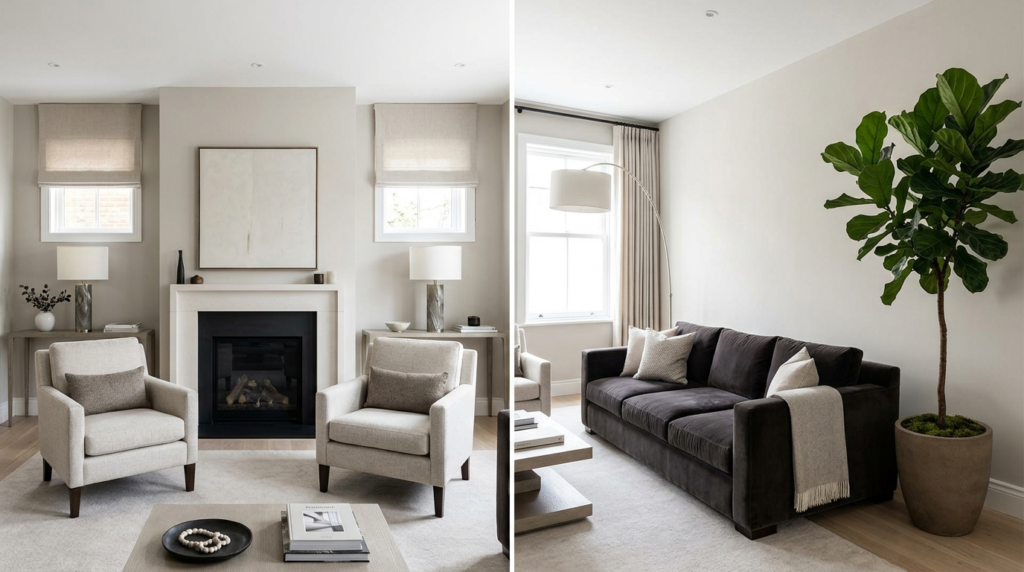
Balance doesn’t mean symmetry. It means the visual ‘weight’ of one side of a room roughly equals the other. A dark, heavy sofa on one side can be balanced by a large piece of art or a tall floor lamp on the opposite side. Symmetrical balance (matching nightstands, paired chairs) feels formal. Asymmetrical balance feels more relaxed and modern — and is far more forgiving to work with.
2. Scale and Proportion
The most common decorating mistake in America is buying furniture that’s the wrong scale for the room. An oversized sectional in a small living room crowds the space. A tiny rug under a large dining table looks like a floating postage stamp. Rule of thumb: leave 18–24 inches of bare floor on at least two sides of any large piece of furniture, and always buy a rug that extends at least 6 inches beyond the edge of your sofa.
3. Contrast
Without contrast, a room looks flat. Contrast comes from mixing light and dark tones, rough and smooth textures, curved and straight shapes. Even an all-neutral room needs contrast — try pairing a linen sofa with a lacquered side table, or a matte wall finish with glossy picture frames.
4. Focal Point
Every room should have one thing the eye lands on first: a fireplace, a bold piece of art, an accent wall, a statement lighting fixture. Without a focal point, the eye drifts and the room feels unsettled. With one, the whole space snaps into place around it. Decide what your focal point is before you buy a single item of furniture.
5. Flow and Function
Great decor doesn’t sacrifice livability. Leave clear walking paths (at least 36 inches in main traffic areas), ensure your furniture arrangement supports how the room is actually used, and don’t decorate past the point of comfort. A beautiful room nobody wants to sit in is a design failure, not a success.
| Decide your focal point before you buy a single piece of furniture. Every other decision becomes easier from there. |
- Next step: pick the right colors. These living room color schemes and palettes make it easy.
The 8 Most Popular Home Decor Styles (and How to Actually Pull Them Off)
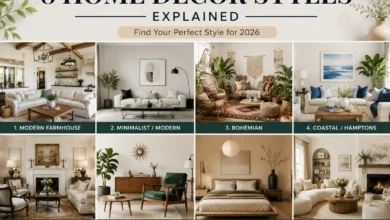
Understanding design styles helps you shop with purpose instead of impulse. You don’t have to pick just one — most well-decorated homes blend two — but having a primary style as your ‘home base’ makes every decision faster and cheaper.
| Style | Budget | Best Room | Key Elements | 2026 Trend? | Difficulty |
|---|---|---|---|---|---|
| Modern Farmhouse | Medium | Living Room, Kitchen | Shiplap, neutrals, black fixtures, barn doors | Evolving → Modern Cottage | Beginner-friendly |
| Minimalist / toModern | Low–High | Bedroom, Studio | Clean lines, neutral tones, hidden storage | Yes — warm minimalism | Intermediate |
| Bohemian | Low | Bedroom, Living Room | Layered textiles, plants, rattan, global patterns | Yes — curated boho | Beginner-friendly |
| Coastal / Hamptons | Medium–High | Living Room, Bath | Blues + whites, linen, driftwood accents | Mild | Intermediate |
| Traditional | High | Formal Living, Dining | Symmetry, rich fabrics, antiques, detailed trim | Evolving → Art Deco | Advanced |
| Mid-Century Modern | Medium | Living Room, Office | Tapered legs, walnut wood, retro accents | Steady evergreen | Intermediate |
| Japandi | Medium | Bedroom, Bathroom | Wabi-sabi textures, muted palette, natural materials | Yes — growing fast | Intermediate |
| Modern Cottage | Medium | Any Room | Curved furniture, warm neutrals, vintage + modern mix | YES — 2026 breakout ★ | Beginner-friendly |
Also Read: 8 HOME DECOR STYLES EXPLAINED
What’s Trending in 2026: Modern Cottage Takes Over
If you’ve been on Pinterest or Instagram in the past six months, you’ve seen it: rooms that feel warm, layered, a little vintage, but not fussy. That’s Modern Cottage — and it’s the dominant style direction of 2026. Think curved sofas, arched doorways, thick vintage-style frames, warm moody paint tones, and antique pieces mixed with clean modern shapes. It’s the natural evolution of Modern Farmhouse, but softer and more personal.
Other 2026 trend callouts worth noting: Art Deco is making a comeback (bold geometry, brass, velvet), layered wall plates are replacing gallery walls in dining rooms, and warm wood tones are replacing cool grays everywhere. Sherwin-Williams’ 2026 Color of the Year leans into warm earthy territory — expect terracotta, deep sage, and rich clay to dominate.
- Want it in the bedroom? Try these modern farmhouse bedroom decor ideas.
Room-by-Room Home Decor Guide
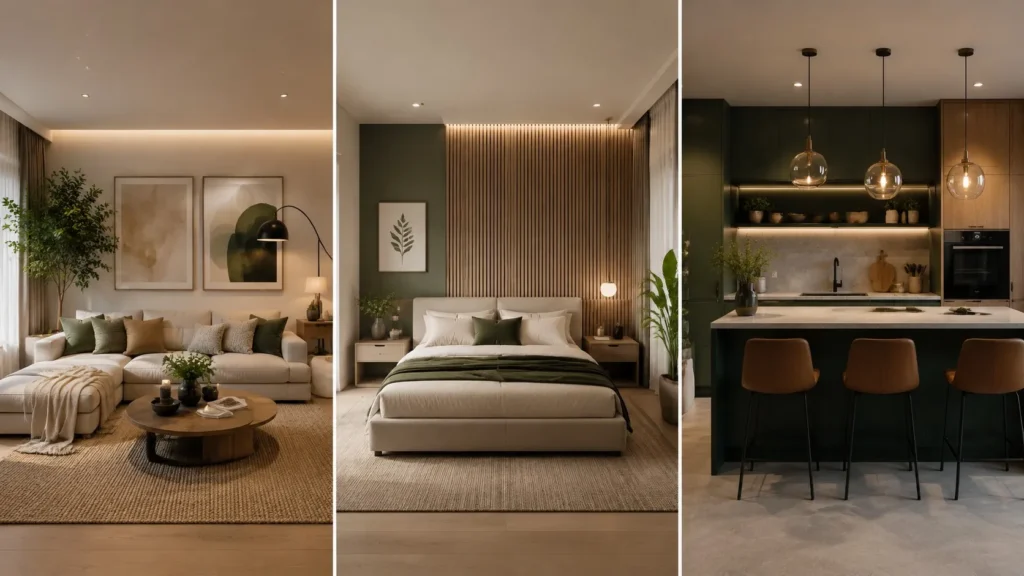
Living Room Decor: The Room That Does Everything
The living room is your most-used, most-seen space — and the most expensive to get wrong. Start here before decorating anywhere else, because your living room palette will guide the rest of your home.
Layout First, Furniture Second
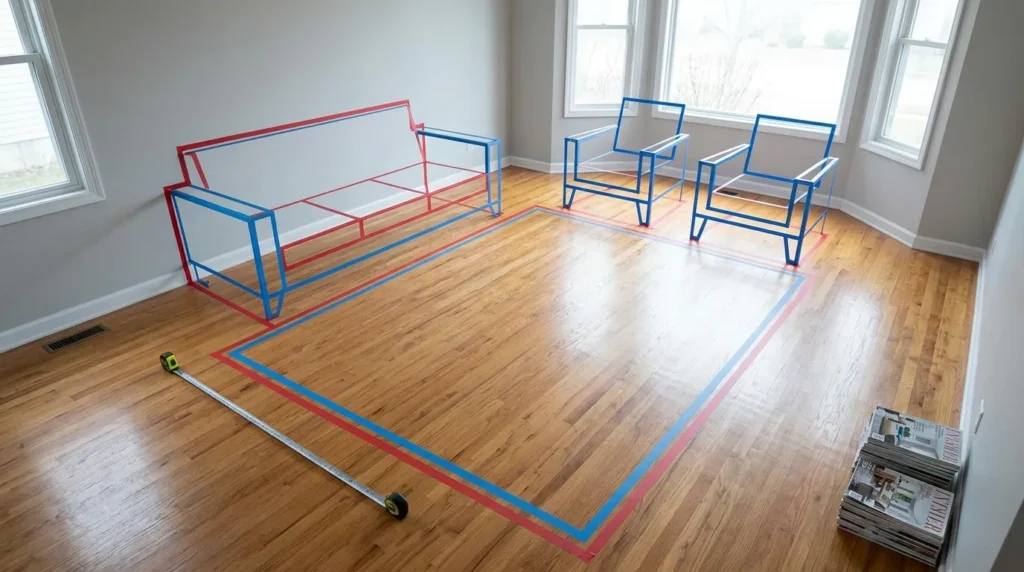
Before buying anything, tape out your furniture plan on the floor. The biggest layout mistake: pushing all furniture against the walls. Floating your sofa and chairs 12–18 inches from the walls actually makes the room feel larger and more intentional. Create a conversation zone — furniture should face each other, not just the TV.
- Anchor the seating area with a rug that fits under at least the front legs of every piece of furniture
- Place your largest piece (usually the sofa) facing the focal point — fireplace, TV, or statement wall
- Add one piece of unexpected texture: a bouclé throw, a rattan tray, a velvet accent pillow
- Layer lighting: overhead, floor lamp, and table lamp — never rely on one ceiling fixture alone
- Add one living element — a large plant, a collection of smaller ones, or fresh flowers
Bedroom Decor: Your Rest Sanctuary
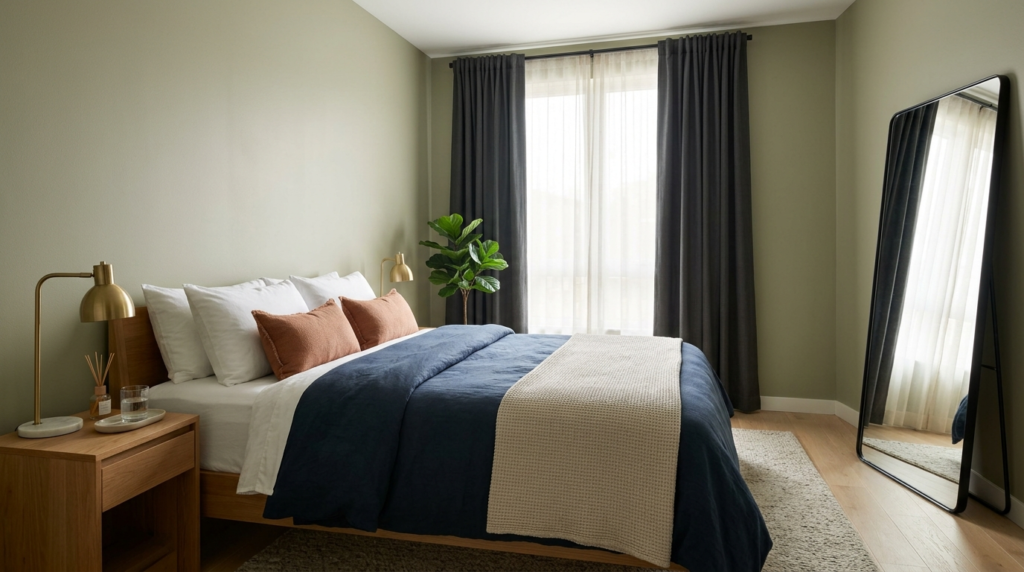
The bedroom is the one room where function literally equals health. Poor lighting, cluttered surfaces, and wrong color choices directly impact sleep quality. Treat it differently than any other room in your home.
The 3-Layer Bedding Method
This is the single easiest upgrade most bedrooms need: a fitted sheet, a duvet or comforter, and a throw blanket folded at the foot. Add two sleeping pillows plus two decorative pillows. The result looks like a hotel, costs almost nothing extra, and takes 30 seconds more to make in the morning.
- Choose warm, muted tones for walls — soft terracotta, sage, warm white, or deep navy are all proven sleep-supportive palettes
- Blackout curtains over sheer panels gives you daytime softness and nighttime function
- Nightstands should be roughly the same height as your mattress top — typically 24–28 inches
- A full-length mirror makes any bedroom feel 30% larger
- Keep surfaces clear: one lamp, one small tray, done
Kitchen Decor: Style Without Sacrificing Function
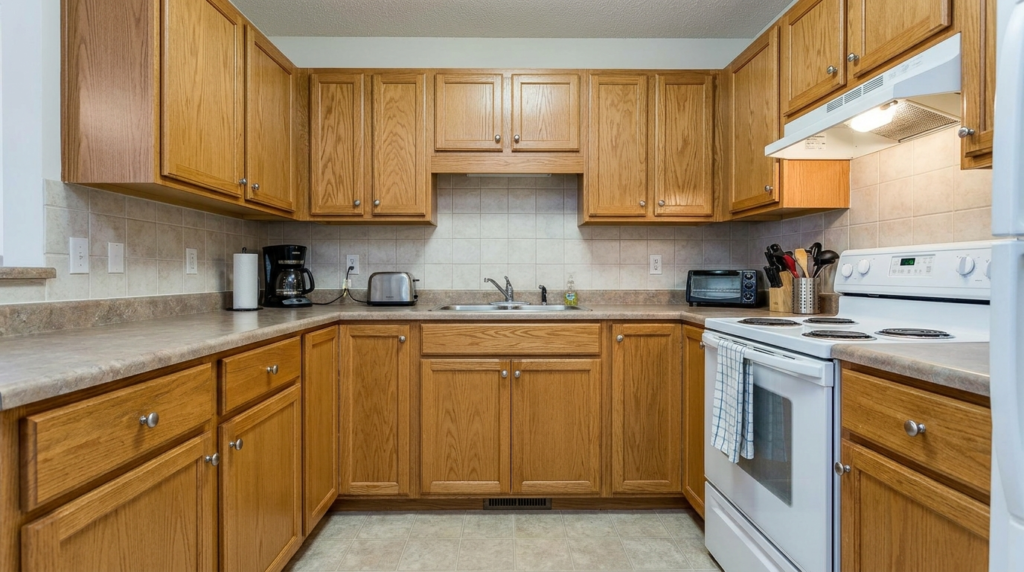
Most kitchen decor advice ignores the reality that kitchens are workspaces first. The goal is to add personality without creating clutter that makes cooking harder.
The Open Shelf Debate
Open shelves look great when kitchens are kept meticulously curated. If that’s not your reality, use closed cabinets and style one or two open shelves with intentional items only: a few beautiful plates, a small plant, a cookbook. Don’t open-shelf your entire kitchen unless you’re committed to keeping it curated permanently.
- Update cabinet hardware for under $100 — this single change visually transforms an entire kitchen
- Add a peel-and-stick backsplash behind the stove for instant personality (renter-safe, fully removable)
- Use open canisters for dry goods on the counter — they’re functional and decorative at the same time
- Hang a pendant light over the island or sink; it immediately elevates the space
- Keep countertops at 70% capacity — visual breathing room makes kitchens look bigger and cleaner
Bathroom Decor: Big Impact in the Smallest Space
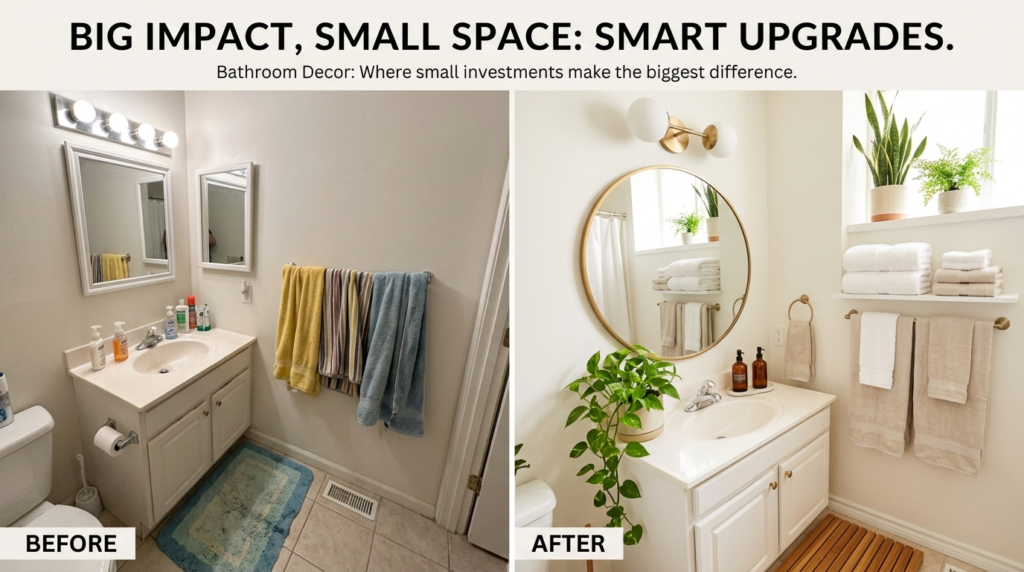
The bathroom is where small investments make the biggest visual difference. Nobody spends two hours in their bathroom — but everyone notices it the moment they walk in.
- Swap builder-grade light fixtures over the mirror — this is almost always the ugliest part of a stock bathroom and costs $50–$200 to fix
- Add a real wood bath mat instead of standard terry cloth — warmer, more stylish, and dries faster
- Use a matching set of white or linen towels: eliminates visual chaos from mismatched colors
- A large mirror (or two smaller ones) makes every bathroom look more expensive and more spacious
- Plants that love humidity — pothos, snake plants, ferns — thrive in bathrooms and add life without effort
Small Space Decor: For Apartments, Studios, and Compact Rooms
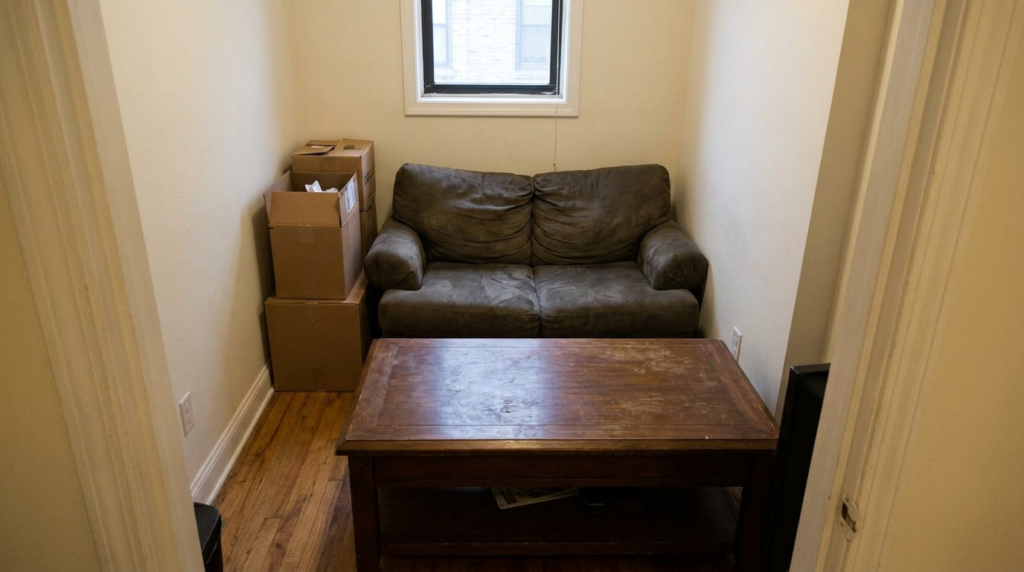
Over 44 million Americans rent, and the majority live in spaces under 1,000 square feet. If this is you, standard decor guides written for 2,500 sq ft suburban homes aren’t built for your life. Here’s what actually works in compact spaces.
- Go vertical. Floor-to-ceiling shelving draws the eye up and doubles storage without using floor space.
- Use mirrors strategically. A large mirror opposite a window reflects light and visually doubles the space.
- Choose furniture with legs. Sofas and tables on legs let light pass underneath — the room breathes.
- Multi-functional is mandatory. An ottoman with storage, an extendable dining table, a sofa bed — every piece must earn its square footage.
- One large rug beats several small ones. A room-sized rug unifies a studio or open-plan space. Three small rugs create visual fragmentation.
- Renting? Nail it with these renter-safe decorating tips.
Budget-Friendly Home Decor: Real Ideas by Price Tier
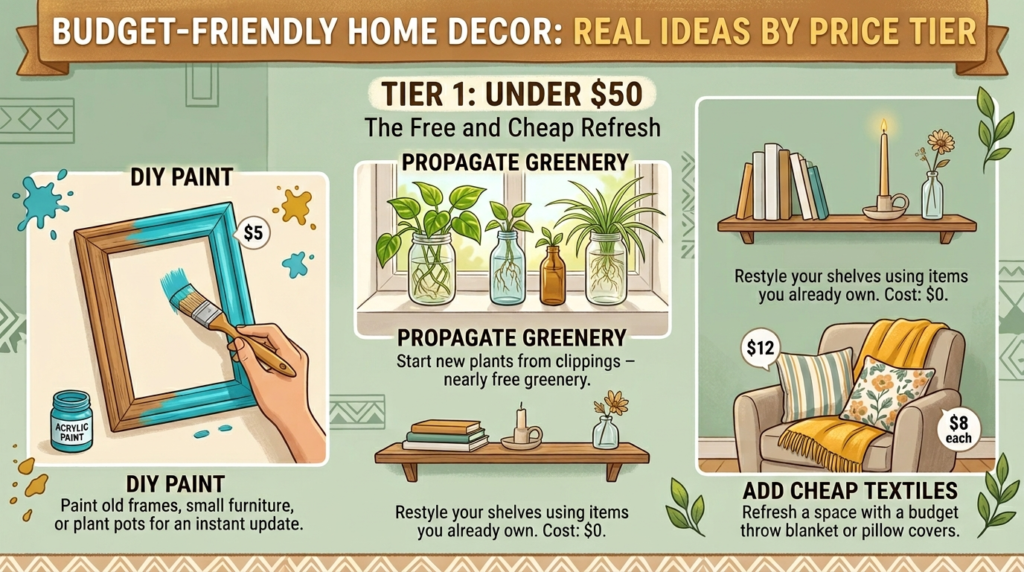
Under $50: The Free and Cheap Refresh
- Rearrange your furniture — it costs nothing and completely changes a room
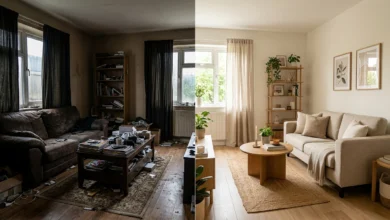
- Declutter aggressively: removing 30% of items from any surface makes it look styled
- Change your throw pillow covers (not the inserts) — covers start at $8–$15 each
- Add a $12 plant from your local hardware store — pothos and snake plants are nearly indestructible
- Frame art you already own, or print free digital art from public domain archives
$50–$200: The Biggest Bang for Your Buck
- A new lamp (floor or table) transforms lighting better than any overhead fixture upgrade
- Peel-and-stick wallpaper on one accent wall: $40–$120 for a 12 ft section, fully removable
- New cabinet hardware for a kitchen or bathroom: typically $60–$120 for a full set
- A quality throw blanket in your room’s accent color: $30–$80
- Second-hand furniture from Facebook Marketplace, Craigslist, or thrift stores — often $20–$100 for pieces that would cost 10x retail
$200–$500: The Room Refresh
- A gallon of paint for an accent wall or full room: $60–$85 plus $30 in supplies — the highest ROI home improvement you can make
- New window treatments: curtains or Roman shades from IKEA, Target, or Amazon dramatically change the feel of a room
- A new area rug: the foundation of any room’s design. Budget $150–$400 for a quality 8×10
- Lighting upgrade: a statement pendant or chandelier in a dining area or bedroom ($80–$300)
| PRO TIP: The Order of Operations Always invest in: Paint → Rug → Lighting → Furniture — in that sequence. Furniture is the most expensive and the least visually impactful at the room level. A $40 paint job does more for a room than a $400 side table. Don’t buy furniture until your foundation decisions (paint, flooring, light) are locked in. |
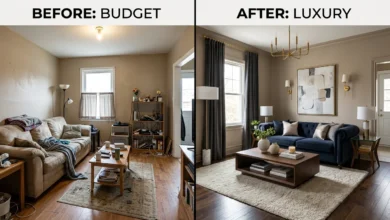
- Want it to look high-end? Try this budget home decor that looks expensive.
Color Psychology and Lighting: The Science Behind Beautiful Rooms
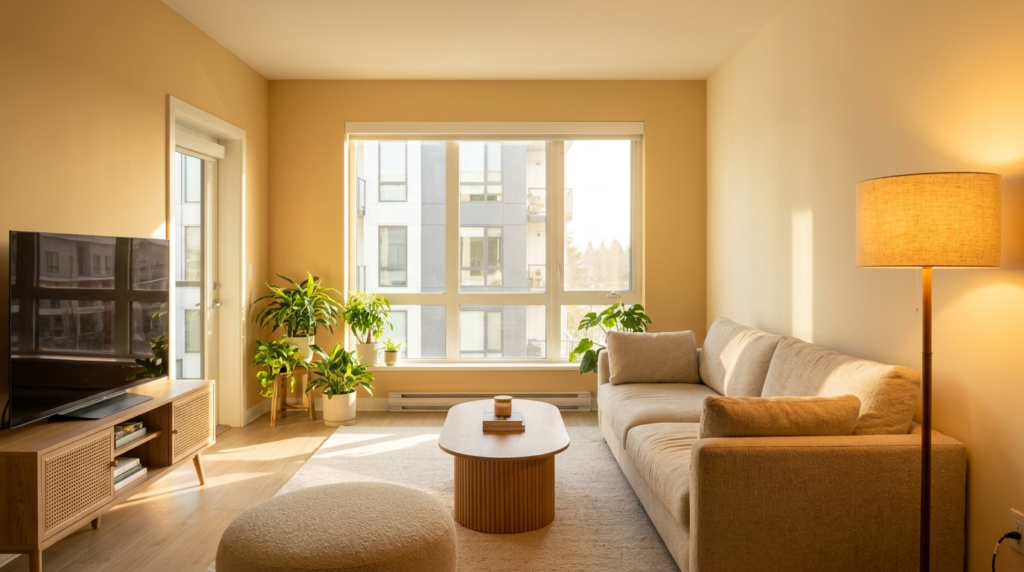
How Color Affects How a Room Feels
Colors aren’t just aesthetic — they trigger physiological and psychological responses. This is documented in environmental psychology research and used by interior designers at every level.
- Blues and greens: Lower heart rate and cortisol. Use them in bedrooms, home offices, and bathrooms — anywhere you want calm.
- Warm reds and oranges: Stimulate energy and appetite. Perfect for dining rooms and kitchens; avoid in bedrooms.
- Yellows: Create optimism and energy — great for kitchens and entryways, but overwhelming in large doses in a bedroom.
- Warm whites and creams: Feel welcoming rather than stark. Pure bright white can feel clinical — opt for warm-toned whites like Benjamin Moore White Dove or Sherwin-Williams Alabaster.
- Deep, moody tones: (navy, forest green, deep charcoal) Make large rooms feel intentional and cozy instead of cavernous.
The 3 Lighting Layers Every Room Needs
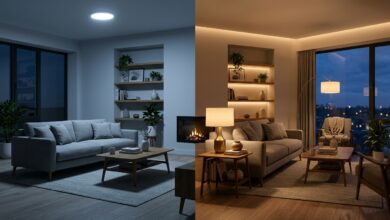
Most homes have one type of lighting (overhead/ambient) and nothing else. That’s why they look flat. Professional designers always layer three types:
- Ambient light: The overall room light — a ceiling fixture, recessed lights, or a chandelier. Your base layer, not your only layer.
- Task light: Directed, functional lighting — a desk lamp, under-cabinet kitchen lights, a reading lamp. Serves a specific purpose.
- Accent light: Decorative and mood-setting — LED strips under a shelf, a picture light above art, a small lamp on a bookcase. Makes a room feel warm and dimensional in the evening.
The fastest lighting upgrade in any room: put your lamps on smart bulbs ($10–$15 each) set to warm white (2700K) in the evening. The difference compared to cool white overhead lighting is immediate and dramatic.
Seasonal and 2026 Trending Home Decor Ideas
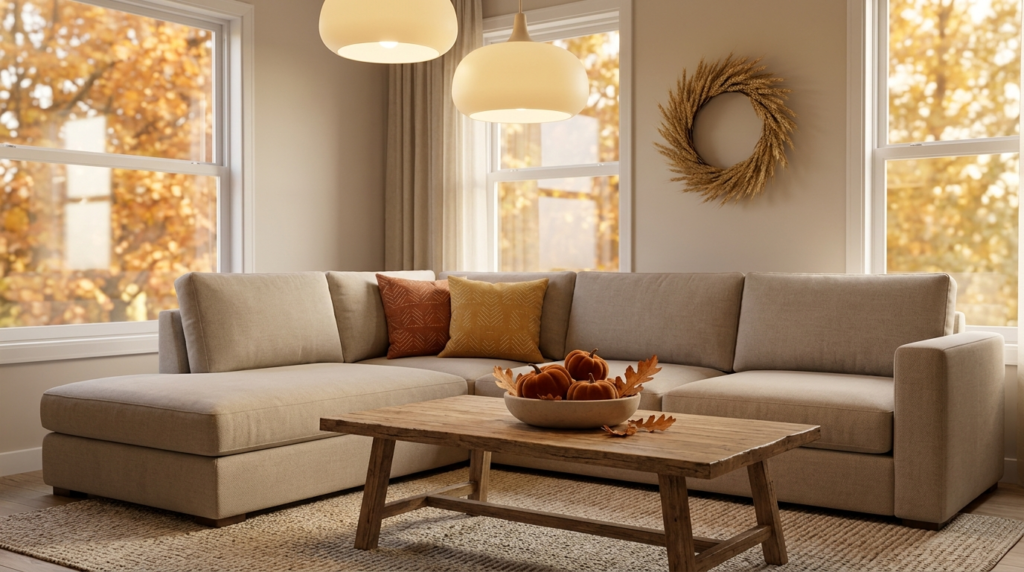
The smartest way to incorporate seasonal decor without overspending: keep your base decor permanent (furniture, rugs, wall color, lighting), and rotate just the accents — throw pillows, table decor, a candle scent, a wreath. Budget $50–$100 per seasonal swap and store off-season items in labeled bins.
The Biggest 2026 Home Decor Trends Right Now
- Plate wall displays: Collections of decorative plates on walls are replacing traditional gallery walls in dining rooms, kitchens, and living rooms. Easy to DIY, renter-safe with plate hangers.
- Warm wood tones everywhere: Cool gray is officially over. Warm walnut, honey oak, and teak are replacing it in furniture, floors, and cabinetry.
- Antiques as focal pieces: One intentional vintage or antique piece grounds a modern room in a way no mass-market item can.
- Moody, saturated colors: Deep burgundy trim, forest green walls, and clay-toned ceilings are dominating 2026 design. Pair with lighter furniture to avoid overwhelm.
- Art Deco revival: Geometric shapes, brass fixtures, velvet textures, and bold symmetry are making a genuine comeback — especially in bathrooms and dining rooms.
The Home Decor Process: Step-by-Step
Use this as your room-by-room action plan. Work through each step in sequence before moving to the next — skipping ahead is why most decorating projects stall or go over budget.
| # | Step | What to Do |
|---|---|---|
| 01 | Define the Room’s Purpose | List the 3 main functions the room serves. Every decor decision filters through this. A home office that doubles as a guest room has different needs than a dedicated living room. |
| 02 | Set Your Budget (with a 20% buffer) | Divide your budget: 40% furniture, 25% lighting, 20% textiles + accessories, 15% art + plants. Always keep 20% in reserve for surprises. |
| 03 | Choose Your Style Anchor | Pick one primary style and one secondary. Your primary drives 70% of decisions; the secondary adds personality and prevents the room from looking like a showroom. |
| 04 | Select Your Color Palette | Apply the 60-30-10 rule: 60% dominant color (walls, main furniture), 30% secondary color (rugs, drapes), 10% pop color (throw pillows, art, accessories). |
| 05 | Plan Your Furniture Layout | Tape the floor plan before buying anything. Identify your focal point, walking paths (36 inches minimum), and conversation zones. Measure twice, buy once. |
| 06 | Layer Your Lighting | Add all three layers: ambient, task, and accent. Use warm white (2700K) bulbs in the evening. Plan lighting at the same time as furniture — never as an afterthought. |
| 07 | Add Textiles and Soft Furnishings | Rugs, throw pillows, curtains, blankets. Add texture contrast: smooth + rough, matte + shiny. This layer is reversible and affordable — experiment freely. |
| 08 | Finish with Art, Plants, and Accessories | The final 10% of your budget makes the biggest personality statement. Group accessories in odd numbers, vary heights, and always include at least one living element — a plant. |
| Step | Step Name | Visual Description for Designer |
| 01 | Define Purpose | Icon: Clipboard with 3 checkboxes. Visual: Simple room outline with 3 labeled function tags floating around it (e.g., ‘Work’, ‘Entertain’, ‘Rest’). Highlight: ‘Every decision flows from this.’ |
| 02 | Set Budget | Icon: Pie chart divided into 4 color-coded sections (40%/25%/20%/15%). Visual: Budget allocation wheel with labeled segments. Side callout: ‘+20% buffer’ badge in terracotta. |
| 03 | Choose Style | Icon: Style mood board with 2 overlapping frames (primary + secondary). Visual: Show two small room thumbnail swatches side by side. Label: ’70/30 blend rule.’ Highlight 2026 Modern Cottage example. |
| 04 | Color Palette | Icon: Paint bucket with 3 color swatches spilling out. Visual: Large color bar divided 60/30/10 with sample hex codes beneath each section. Mini room silhouette showing rule applied. |
| 05 | Furniture Layout | Icon: Top-down floor plan with dotted layout lines. Visual: Simple room grid with furniture blocks placed, 36″ walkway arrows labeled, focal point star marker. Callout: ‘Tape first, buy second.’ |
| 06 | Layer Lighting | Icon: Three lightbulb icons in a triangle (ambient/task/accent). Visual: Room cross-section with 3 light source types labeled and beam paths shown. Callout: ‘2700K warm white’ badge. |
| 07 | Textiles | Icon: Folded throw blanket + rug corner. Visual: Texture grid showing 4 fabric/material swatches (linen, velvet, jute, cotton). Callout badge: ‘Most reversible layer — experiment freely.’ |
| 08 | Art & Accessories | Icon: Picture frame + plant + candle trio in odd grouping. Visual: Shelf vignette with height variation illustrated and ‘rule of three’ label. Final step glow effect — terracotta ring around step number. |
The 7 Most Common Home Decor Mistakes (and Exactly How to Fix Them)
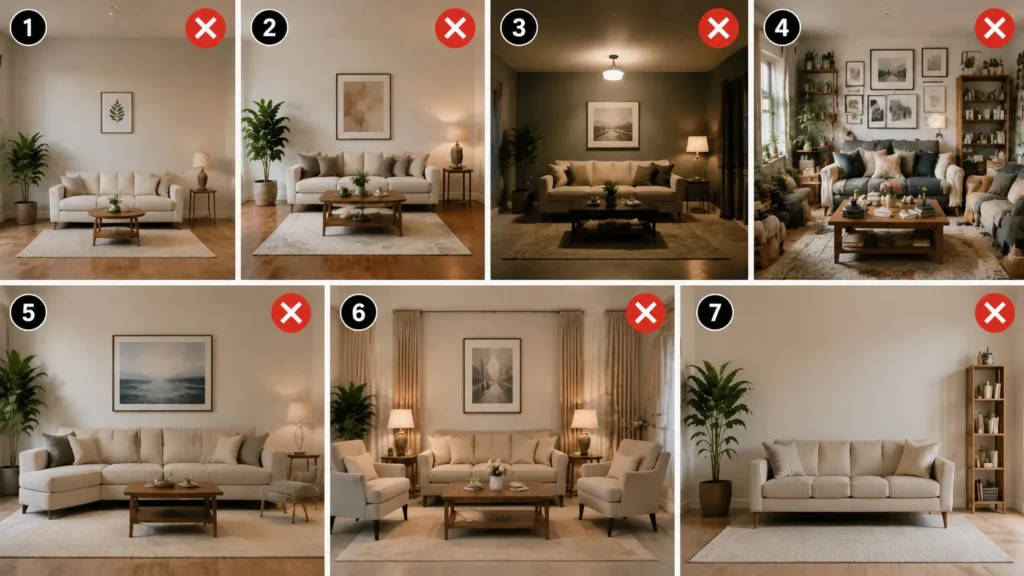
- Too-small rugs. If any furniture leg is fully off the rug, the rug is too small. In living rooms, the rug should anchor the entire seating area. When in doubt, go one size larger.
- Art hung too high. The center of artwork should sit at approximately 57–60 inches from the floor — roughly eye level. Most people hang art 6–12 inches too high, which disconnects it from furniture below.
- All furniture against the walls. This creates a ‘waiting room’ layout. Float your furniture 12–24 inches from walls to create intimacy and flow.
- Matchy-matchy furniture sets. A complete matching set looks like a showroom display. Mix pieces from different sources — one vintage, one new, one thrifted.
- Ignoring lighting until the end. Lighting is infrastructure, not an afterthought. Plan your lighting layers at the same time as your furniture layout.
- Over-decorating every surface. Editing is as important as adding. A surface with 3 intentional items looks more styled than one with 12 random objects. Declutter first, decorate second.
- Skipping the ceiling. The ceiling is the fifth wall and most people ignore it. A different paint color, wallpaper, or statement light fixture transforms a room for under $200.
- If your living room is small and you’re on a tight budget, these budget small living room ideas are perfect for you.
Conclusion
Decorating your home doesn’t have to be expensive, complicated, or intimidating. As this guide has shown, the best home decor comes down to a handful of principles — balance, scale, contrast, focal points, and flow — applied consistently across every room, every budget, and every style.
Whether you’re refreshing a small apartment on a $50 budget or committing to a full room transformation with 2026’s breakout Modern Cottage aesthetic, the process is the same: start with purpose, anchor your decisions in a clear style direction, and invest in the fundamentals first. Paint, lighting, and rugs will always outperform an expensive accent chair in terms of visual impact.
The most important takeaway? Great home decor is personal. Trends come and go — warm wood tones are in, cool grays are out, Art Deco is back — but a space that genuinely reflects how you live will always feel more “designed” than one that chases the algorithm.
Use the step-by-step process in this guide as your roadmap, avoid the seven common mistakes, and trust that small, intentional changes compound quickly. You don’t need to redo everything at once. Start with one room, one wall, or even one lamp — and build from there.
Your home is the environment you live inside every single day. It’s worth getting right.
Frequently Asked Questions About Home Decor
How do I start decorating my home if I have no idea where to begin?
Start with function, not aesthetics. Ask yourself: what does this room need to do for me? Then pick one focal point — one thing the room will be ‘about.’ Everything else supports that decision. Start with the biggest piece of furniture (usually a sofa or bed), choose a color palette from it, and build outward from there. Don’t try to decorate an entire home at once.
What is the best home decor style for 2026?
Modern Cottage is the breakout style of 2026 — it blends the warmth of farmhouse design with curved shapes, vintage pieces, and richer, moodier colors. It feels personal and lived-in rather than catalog-perfect. Art Deco is also seeing a strong revival, particularly in dining rooms and bathrooms. That said, the most lasting advice is to choose a style that reflects your life — not the current trend cycle.
How can I make my home look nice without spending a lot of money?
The highest-impact, lowest-cost moves: (1) Declutter — removing things is free and immediately makes a space look more styled. (2) Rearrange your furniture. (3) Paint one wall or your front door. (4) Add a floor lamp. (5) Buy one large plant. These five things cost under $150 total and most people see bigger results from them than from buying new furniture.
What is the 60-30-10 color rule in home decor?
The 60-30-10 rule is a simple formula for creating balanced color schemes: 60% of the room uses your dominant color (typically walls and large furniture), 30% uses a secondary color (drapes, accent chairs, rugs), and 10% is a bold accent color (throw pillows, art, accessories). It works in any style at any budget and prevents the ‘too many colors’ or ‘too boring’ problems most rooms struggle with.
How do I decorate a small living room to make it look bigger?
Key moves: use one large rug instead of multiple small ones; choose furniture with exposed legs so light passes underneath; hang curtains as close to the ceiling as possible; use light, warm paint colors; add a large mirror opposite a window; and float furniture away from walls rather than pushing everything against them. Resist filling every corner — negative space is what makes a small room feel spacious.
What color makes a room look bigger?
Light, warm neutrals — soft whites, creams, warm greiges, and pale sage — visually expand a room the most. The key word is ‘warm’ not ‘cool’: pure bright white can feel stark and actually emphasize a room’s limits. Warm whites like Benjamin Moore White Dove (OC-17) or Sherwin-Williams Alabaster (SW 7008) are perennial favorites among professional designers for small spaces.
How high should I hang wall art?
The standard rule is to hang the center of the artwork at approximately 57–60 inches from the floor — roughly eye level for an average standing adult. This applies whether you’re hanging a single piece or creating a gallery wall (treat the gallery as one unit and center that group at 58–60 inches). The most common mistake is hanging art too high, which disconnects it from furniture and makes the room feel unsettled.
What are the best plants for home decor?
For style and ease: pothos (tolerates any light, trails beautifully from shelves), snake plant (architectural shape, nearly indestructible), fiddle-leaf fig (statement tree for bright rooms), peace lily (low light, flowers, air-purifying), and ZZ plant (thrives on neglect, modern glossy leaves). For bathrooms specifically, ferns, pothos, and air plants love the humidity. Start with pothos if you’ve killed plants before — it’s essentially unkillable.