Of all the design decisions that go into a bathroom, lighting is the one most likely to get overlooked — and the one that has the biggest daily impact once it’s wrong. A beautifully tiled bathroom with the wrong lighting can still leave you squinting into a dim mirror every morning, while a modestly finished bathroom with well-planned lighting can feel bright, functional, and genuinely pleasant to use.
This guide covers everything you need to know about bathroom lighting: how to layer it correctly, where to place fixtures for the best results, which bulb types actually make a difference, and how to decide whether a DIY fixture swap is enough or whether it’s time to call in a professional. Whether you’re planning a full renovation or simply want to upgrade the light over your mirror, you’ll find practical, real-world guidance here.
Why Bathroom Lighting Deserves More Attention
Bathrooms are unique among the rooms in a house because so much of what happens there depends on how accurately you can see yourself. Shaving, applying makeup, checking your skin, styling your hair — all of these tasks rely on light that’s bright enough, evenly distributed, and close enough to true daylight color to show your actual appearance rather than a flattering or unflattering distortion.
Most builder-grade bathrooms are fitted with a single fixture, usually mounted directly above the mirror or centered on the ceiling, and that single source is rarely enough to support every task the room needs to handle. A thoughtful bathroom lighting plan solves this by using multiple fixture types working together, each suited to a different purpose. Getting this right doesn’t necessarily require a major renovation — in many cases, it comes down to a few well-chosen bathroom lighting fixtures placed in the right spots.
The Three Layers of Bathroom Lighting Explained
Professional lighting designers work with a concept called layered lighting, which applies just as well to a bathroom as it does to a living room or kitchen. The idea is to combine three distinct types of light so the room functions well for every task, rather than relying on one fixture to do everything.
Ambient lighting provides the general, overall illumination for the room. This is typically a ceiling-mounted fixture or a set of recessed can lights, and its job is simply to make the space usable and safely lit as a whole, without necessarily being bright enough on its own for detailed tasks like makeup application.
Task lighting is the layer most people think of first when they picture bathroom lighting ideas, since it’s what illuminates the mirror for grooming tasks. This is the layer most bathrooms get wrong, largely because a single overhead fixture is often mistaken for adequate task lighting when it isn’t — overhead-only lighting casts shadows under the eyes, nose, and chin, which makes it much harder to judge your own appearance accurately.
Accent lighting is the optional, more decorative layer — a statement pendant, a backlit mirror, or a small fixture that highlights a design feature like a tile niche or an architectural detail. This layer isn’t strictly necessary for function, but it adds depth and visual interest, particularly in a bathroom aiming for a more elevated or modern look.
A well-lit bathroom typically uses all three layers together rather than relying on any single one, which is the core principle behind almost every effective bathroom lighting idea covered in this guide.
Bathroom Lighting Above the Mirror: Getting It Right
Bathroom lighting above the mirror is the single most important lighting decision in the entire room, since it directly affects how well you can see your own face for daily grooming tasks. Unfortunately, it’s also the layer that gets misapplied most often.
The most common mistake is relying solely on a fixture centered directly above the mirror. While this is better than no task lighting at all, a single overhead source casts light downward, which creates shadows under the brow, nose, and chin — the exact opposite of the even, shadow-free light needed for shaving or applying makeup accurately.
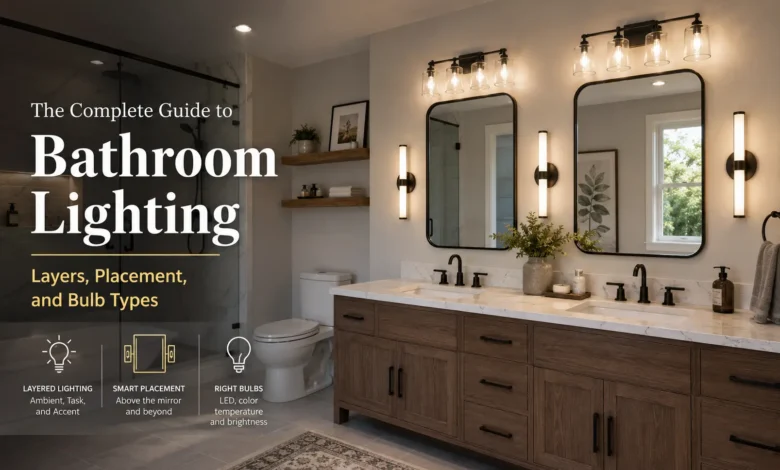
The better approach, and the one most professional designers recommend, is to combine a fixture above the mirror with sconces mounted on either side of the mirror at roughly eye level. This creates light from multiple angles, which fills in the shadows that an overhead-only fixture leaves behind. If side sconces aren’t possible due to space or wiring constraints, a wide light fixture positioned above the mirror — rather than a narrow, centered one — is the next best option, since a wider fixture spreads light across more of the face.
For vanities with mirrors that span the full width of the wall, a linear LED fixture or a row of evenly spaced sconces above the mirror can provide more consistent coverage than a single centered light, particularly for households where more than one person uses the mirror at the same time.
Also Read: Small Bathroom Design Ideas: How to Make a Compact Space Feel Bigger
Bathroom Lighting Fixtures Over the Mirror: Styles and Options
When it comes to choosing bathroom lighting fixtures over the mirror, there’s a wide range of styles to fit almost any design direction, and the right choice often comes down to both the look you want and the layout of your specific bathroom.
Vanity light bars are a straightforward, budget-friendly option that typically house multiple bulbs in a single horizontal fixture. They’re a reliable choice for even light distribution and work well in bathrooms with a single centered mirror.
Wall sconces, mounted on either side of the mirror, remain the gold standard for flattering task lighting, as discussed above. They come in an enormous range of styles, from simple cylindrical fixtures to more decorative designs, which makes them adaptable to almost any bathroom aesthetic.
Backlit or LED-integrated mirrors have become increasingly popular in recent years, particularly in modern bathroom lighting schemes. These mirrors have LED lighting built directly into the frame or behind the glass, providing even, shadow-free illumination without requiring a separate fixture at all. Many also include adjustable brightness and color temperature settings, controlled by a built-in touch sensor.
Pendant lighting, hung on either side of or above the mirror, has become a popular alternative to traditional sconces in more design-forward bathrooms, offering a distinctive look while still providing usable task light if hung at an appropriate height.
Flush or semi-flush ceiling fixtures positioned directly above the vanity work as a supplementary ambient layer but generally shouldn’t be relied on as the sole source of light over the mirror, for the shadow-related reasons already covered.
Modern Bathroom Lighting Ideas by Style
Bathroom lighting doesn’t exist in isolation — it should complement the overall design direction of the room. Here are a few modern bathroom lighting ideas organized by style, to help match fixtures to the bathroom’s broader aesthetic.
Minimalist modern bathrooms tend to favor clean-lined sconces or slim linear LED fixtures in matte black, brushed nickel, or chrome, often paired with a simple, unadorned mirror. The goal is understated, functional light that doesn’t compete visually with the room’s other clean lines.
Warm modern or Scandinavian-inspired bathrooms often use wood or matte brass accents on fixtures, paired with warmer-toned LED bulbs, to create a softer, more inviting version of a modern look rather than a stark, clinical one.
Industrial-style bathrooms frequently incorporate exposed-bulb sconces or fixtures with visible metal cages, which add texture and visual interest while still functioning as effective task lighting when placed correctly beside the mirror.
Spa-inspired modern bathrooms tend to favor soft, diffused light sources — frosted glass sconces or backlit mirrors — that create a gentler, more relaxing ambiance while still providing enough brightness for grooming tasks.
High-contrast modern bathrooms sometimes use a statement pendant or an oversized fixture as a focal point, paired with recessed ambient lighting elsewhere in the room to keep the rest of the space from competing with the main fixture.
LED Bathroom Lighting: Why It’s Become the Standard
LED bathroom lighting has largely replaced incandescent and fluorescent bulbs as the default choice for new installations and renovations, and for good reason. LED bulbs use significantly less energy than incandescent bulbs to produce the same amount of light, which adds up meaningfully over time given how often bathroom lighting is used throughout the day. They also last far longer than traditional bulbs, often rated for tens of thousands of hours compared to roughly a thousand hours for a standard incandescent bulb, which means far fewer bulb changes over the life of the fixture.
Beyond energy savings, LED bathroom lighting offers practical advantages specific to how bathrooms are used. LED bulbs reach full brightness instantly, without the slight delay some fluorescent bulbs have, which matters for a room used briefly but frequently throughout the day. They’re also available in a much wider range of color temperatures than older bulb types, which makes it easier to select a warmth level suited specifically to task lighting at the vanity.
Many newer LED bathroom lighting fixtures, particularly backlit mirrors and vanity bars, come with integrated dimming or adjustable color temperature settings, allowing you to shift between a brighter, cooler light for daytime grooming and a softer, warmer light for evening use — a level of flexibility that wasn’t practical with older lighting technology.
Understanding Color Temperature and Brightness
Color temperature, measured in Kelvin (K), describes how warm or cool a bulb’s light appears, and it has a bigger effect on how a bathroom feels — and how accurately you can judge your own appearance — than most people realize.
Bulbs in the 2700K to 3000K range produce a warm, yellow-toned light similar to traditional incandescent bulbs. This can feel cozy but tends to distort how skin tones and makeup actually look, since it casts everything in a warm tint.
Bulbs in the 3500K to 4000K range are generally considered the sweet spot for bathroom task lighting, since they produce a light that’s warm enough to feel comfortable but neutral enough to closely resemble natural daylight, giving a more accurate read of your appearance in the mirror.
Bulbs above 5000K produce a cool, bluish-white light that can feel harsh or clinical in a residential bathroom, though it’s sometimes used intentionally in more clinical or high-contrast modern designs.
Brightness, measured in lumens rather than watts (a distinction that matters more with LED bulbs, since their wattage-to-brightness ratio differs from older bulb types), also matters. As a general guideline, a bathroom benefits from roughly 70 to 80 lumens per square foot of combined lighting, distributed across the ambient and task layers, though personal preference and the amount of natural light in the room both play a role in the ideal number for any specific space.
Wet, Damp, and Dry Ratings: What Bathroom Lighting Codes Require
Because bathrooms deal with high humidity and, in some areas, direct water exposure, not every light fixture is safe to install in every location within the room. Building codes classify fixtures into three ratings, and understanding them is essential before purchasing any bathroom lighting fixtures.
Wet-rated fixtures are required for any location where a fixture could be directly exposed to water, such as inside a shower or directly above a tub. These fixtures are sealed to prevent moisture intrusion and are the only safe option in these specific locations.
Damp-rated fixtures are designed for areas with high humidity but no direct water contact, which covers most of the rest of a typical bathroom, including fixtures above the vanity or on the ceiling outside the shower or tub area.
Dry-rated fixtures, the standard rating for most fixtures used elsewhere in the home, aren’t suitable for bathroom installation at all, even in a corner of the room that seems relatively dry, since ambient humidity levels in a bathroom are consistently higher than in most other rooms.
Checking a fixture’s rating before purchase is a simple step that prevents both a safety hazard and premature fixture failure, since fixtures installed in a location beyond their rating tend to corrode or fail well before their expected lifespan.
Where to Shop for Bathroom Lighting Fixtures
Bathroom lighting fixtures are available across a wide range of price points and retail channels, and knowing where to look can save both time and money.
Large home improvement retailers, including Home Depot bathroom lighting sections both in-store and online, offer one of the widest and most accessible selections for homeowners, ranging from budget-friendly vanity bars to more design-forward sconces and LED mirrors, often with the ability to filter by style, finish, and wet or damp rating directly on the website. These retailers are a practical starting point for most homeowners because they combine a broad selection with predictable pricing and easy returns if a fixture doesn’t work out once installed.
Lighting-specific retailers and showrooms typically carry a more curated, higher-end selection, which can be worth visiting in person if you want to see finishes and brightness levels firsthand before committing, particularly for a fixture as important as one placed directly above the mirror.
Online marketplaces and specialty lighting sites often provide access to a wider range of styles, including more unique or designer fixtures that aren’t available through big-box retailers, though it’s worth double-checking wet or damp ratings carefully when shopping this way, since product listings don’t always make the rating as visible as an in-store label does.
DIY Fixture Swap vs. Hiring a Bathroom Lighting Contractor
Whether to handle a bathroom lighting upgrade yourself or bring in a bathroom lighting contractor depends largely on the scope of the project and your comfort level working with electrical wiring.
A straightforward fixture swap — replacing an existing vanity light or sconce with a new one at the same electrical location — is a project many confident DIYers can handle, provided the power is properly shut off at the breaker before starting and the new fixture is compatible with the existing wiring. Manufacturer instructions typically walk through this process fixture by fixture.
Adding new fixtures in new locations, such as installing sconces beside a mirror where none previously existed, involves running new electrical wiring, which is a more involved project. This is where hiring a licensed bathroom lighting contractor or electrician becomes the safer and often more cost-effective choice, both because it typically requires a permit and because mistakes in bathroom wiring carry real safety risks given the proximity to water.
Installing recessed lighting or making layout changes to ambient lighting generally also requires a licensed electrician, since it usually involves cutting into the ceiling and rerouting circuits.
If you’re searching for bathroom lighting upgrades near me in the USA, it’s worth getting quotes from at least two or three licensed local electricians or contractors, since pricing can vary significantly by region and by the complexity of the specific job. Many electricians offer a free or low-cost initial consultation, which is a useful way to get a realistic estimate before committing to a full lighting upgrade.
Bathroom Lighting Ideas for Different Room Types
Not every bathroom needs the same lighting approach. A few bathroom lighting ideas tailored to specific room types can help you prioritize where to invest.
Primary or en-suite bathrooms, which see the heaviest daily use, benefit most from a full three-layer lighting plan, including dedicated task lighting on both sides of a double vanity if two people use the space at once.
Powder rooms, used briefly by guests rather than for daily grooming, offer more room for a decorative statement fixture, such as a bold pendant or an oversized sconce, since functional task lighting matters less in a room without a shower or full vanity routine.
Guest bathrooms benefit from straightforward, reliable lighting — a wide vanity fixture and adequate ambient light — without necessarily needing the same level of layered detail as a primary bathroom, since the room serves occasional rather than daily use.
Windowless bathrooms, which lack any natural daylight, benefit particularly from LED bathroom lighting in the 3500K to 4000K range, since there’s no natural light to supplement or balance out a lower-quality artificial source.
Common Bathroom Lighting Mistakes to Avoid
A handful of mistakes come up repeatedly in bathroom lighting, and most are inexpensive to avoid if caught before installation.
Relying on a single overhead fixture for both ambient and task lighting is the most common mistake, leading to the shadow issues discussed earlier in this guide. Adding side sconces or a wider fixture above the mirror solves this in most cases.
Choosing the wrong color temperature can make even a well-placed fixture feel off — either too yellow to judge appearance accurately or too cool and clinical for a comfortable residential feel. The 3500K to 4000K range is a safe default for most vanity lighting.
Installing a dry-rated fixture in a damp or wet location is both a safety issue and a durability issue, since these fixtures aren’t built to withstand bathroom humidity and will fail well ahead of their expected lifespan.
Underestimating brightness needs by choosing a single small fixture for a large vanity or a double-sink setup often leaves the room feeling dim, particularly in the evening or in a windowless bathroom without natural light to supplement it.
Ignoring dimmer compatibility when purchasing LED bulbs or fixtures can lead to flickering or buzzing if a non-dimmable LED is installed on a dimmer switch, so it’s worth confirming compatibility before purchase if a dimmer is part of the plan.
Budgeting for a Bathroom Lighting Upgrade
Bathroom lighting upgrades span a wide budget range, depending on the scope of the project. A simple fixture swap — replacing one vanity light with a new one at the same location — is one of the more affordable bathroom updates available, particularly as a DIY project, since it doesn’t typically require new wiring or a permit.
Adding new sconces beside the mirror, upgrading to a backlit LED mirror, or incorporating a dimmer switch represents a mid-range investment, and typically involves at least some professional labor for the electrical work, even if the fixtures themselves are moderately priced.
A full lighting overhaul — recessed ambient lighting, new task lighting, a statement accent fixture, and updated switches or dimmers throughout — represents the higher end of the budget range and is most commonly done as part of a broader bathroom renovation, since much of the electrical work is easiest to complete while walls and ceilings are already open.
Regardless of budget, prioritizing task lighting above the mirror tends to deliver the most noticeable day-to-day improvement relative to cost, which makes it a sensible starting point if you’re upgrading in phases rather than all at once.
Frequently Asked Questions
What’s the best bathroom lighting above the mirror?
A combination of a fixture above the mirror and sconces on either side at eye level provides the most even, shadow-free light for grooming tasks. If side sconces aren’t feasible, a wide fixture centered above the mirror is the next best option.
What color temperature is best for bathroom lighting?
Most designers recommend 3500K to 4000K for vanity task lighting, since it closely resembles natural daylight without feeling as warm as a 2700K bulb or as cold as a 5000K bulb.
Can I install bathroom lighting fixtures myself? A direct fixture swap at an existing electrical location is often manageable as a DIY project. Adding new wiring, installing recessed lighting, or making layout changes generally requires a licensed electrician or bathroom lighting contractor.
Are LED bulbs worth it for bathroom lighting?
Yes — LED bathroom lighting uses less energy, lasts significantly longer than incandescent bulbs, and is available in a wider range of color temperatures, making it easier to find the right warmth for vanity lighting specifically.
Where can I buy affordable bathroom lighting fixtures?
Large home improvement retailers, including Home Depot bathroom lighting sections, typically offer the widest and most budget-friendly selection, with filtering options for style, finish, and wet or damp rating.
How do I find a reliable bathroom lighting contractor near me?
Getting quotes from two or three licensed local electricians is the most reliable way to compare pricing and find a contractor experienced with bathroom-specific wiring and code requirements in your area.
Final Thoughts
Good bathroom lighting isn’t about a single perfect fixture — it’s about layering ambient, task, and accent light so the room works well for every task you actually use it for, from a quick morning routine to a relaxing evening soak. Prioritizing well-placed task lighting above the mirror, choosing an LED bulb in the 3500K to 4000K range, and respecting wet and damp rating requirements will solve the vast majority of common bathroom lighting problems, whether you’re making a small fixture swap or planning a full renovation.
For more guidance on the rest of your bathroom project, explore these related guides: